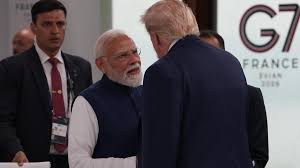
When Prime Minister Narendra Modi and US President Donald Trump met on the sidelines of the G7 Summit in France on Tuesday, it was more than a customary diplomatic interaction. The brief exchange marked the first face-to-face meeting between the two leaders in 16 months and came after one of the most challenging phases in India-US relations since Trump’s return to the White House.
The familiar Modi-Trump embrace was notably absent. Instead, the meeting reflected a relationship that has faced growing strains in recent months but remains too important for either side to ignore.
A series of issues have tested ties between New Delhi and Washington, including trade disputes, tariffs, immigration policies affecting Indian professionals and students, Trump’s repeated claims that he helped broker a ceasefire between India and Pakistan, India’s continued purchase of Russian oil, and criticism in India following the deaths of three Indian sailors in a recent US military strike near Oman.
Against this backdrop, Modi and Trump are expected to hold bilateral talks on Wednesday, with both sides looking to address key areas of concern while preserving a partnership that remains strategically significant.
Trade deal high on India’s agenda
For New Delhi, trade is likely to be among the top priorities during the discussions. Officials from both countries have spent months working towards an interim trade agreement, even as Trump’s tariff policies continue to create uncertainty for Indian exporters.
India is keen to ensure that trade disagreements do not escalate and derail broader economic cooperation.
According to a News18 report, Commerce Secretary Rajesh Agrawal recently confirmed that US Trade Representative Jamieson Greer will visit New Delhi on June 22 for discussions aimed at advancing the proposed India-US interim trade agreement.
Greer is scheduled to hold talks with Commerce and Industry Minister Piyush Goyal on June 23 and 24.
According to Agrawal, the discussions will focus on “giving final touches to the framework deal” negotiated during recent delegation-level meetings, as well as progressing work on the broader Bilateral Trade Agreement (BTA) under discussion between the two countries.
Energy security and regional stability
Energy security is another issue likely to feature prominently in the talks. The G7 Summit comes at a time when the United States and Iran have reached a hard-fought diplomatic agreement, easing immediate tensions in West Asia. However, concerns over global energy supplies remain.
As one of the world’s largest importers of crude oil, India is closely monitoring developments involving Iran, the Strait of Hormuz and regional stability.
Any disruption in energy markets has direct implications for India’s economy, making the issue particularly important for New Delhi.
Concerns over visas and immigration
India is also expected to seek greater clarity on US immigration policies affecting Indian professionals and students.
Changes introduced by the Trump administration have generated uncertainty among those relying on work and study opportunities in the United States.
Although a US federal judge recently struck down Trump’s proposed $100,000 fee on new H-1B visas, ruling it unlawful, the administration has announced plans to appeal the decision, meaning the matter remains unresolved.
For India, the future of visa programmes remains an important concern given the large Indian community working and studying in the United States.
Why Trump needs India too
The meeting is equally significant for Washington. India remains one of the fastest-growing major economies and an increasingly influential player in the Indo-Pacific region.
For the Trump administration, stronger ties with India support broader efforts to counter China’s influence while maintaining access to one of the world’s largest consumer markets.
American companies continue to view India as a major destination for investment and expansion despite long-standing disagreements over tariffs and market access.
Progress on a trade agreement would offer a tangible economic and political achievement for both governments.
India’s strategic value has also increased as the United States seeks dependable partners amid ongoing conflicts and geopolitical tensions across Europe and West Asia.
Political challenges remain
The talks, however, are taking place under a cloud of political sensitivities. Opposition parties in India have questioned the timing of the engagement following the deaths of three Indian sailors in a US military strike near Oman.
Trump’s repeated assertions that he played a role in ending the 2025 India-Pakistan conflict have also caused unease in New Delhi, which has consistently maintained that there was no third-party mediation.
Differences over Russian oil imports and trade policies continue to add complexity to the relationship.
Beyond the handshake
The significance of the Modi-Trump meeting extends far beyond the brief public interaction witnessed at the summit.
After more than a year of growing friction, both leaders appear to recognise that continued engagement serves their national interests better than allowing differences to widen.
The personal warmth that once defined the Modi-Trump relationship may not be as visible as before, but the strategic importance of the India-US partnership remains unchanged.
For both New Delhi and Washington, the challenge now is to manage disagreements without allowing them to overshadow one of the world’s most consequential bilateral relationships.
Bureau Report
Leave a Reply