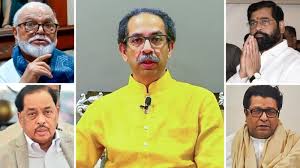
The Uddhav Thackeray-led Shiv Sena (Uddhav Balasaheb Thackeray) is once again grappling with rebellion in its ranks, after reports emerged on Wednesday that six of its Lok Sabha MPs had thrown their weight behind Eknath Shinde. Political watchers say this is hardly new territory for the party; internal revolts have shadowed it for the better part of thirty-five years.
Balasaheb Thackeray founded the Shiv Sena on 19 June 1966, building it around Marathi pride and Hindutva politics. In the decades since, the party has been rocked by one major split after another, with almost every ten-year stretch producing a senior figure who chose to walk away.
The earliest serious blow to Thackeray’s authority came in 1991, when Chhagan Bhujbal, a prominent OBC leader within the party, broke ranks. Frustrated with how the organisation was run and where he stood within it, Bhujbal left, taking 17 MLAs with him and threw in his lot with Sharad Pawar. He would go on to hold ministerial office and serve as Deputy Chief Minister under Congress-NCP governments, the first time a legislative revolt had struck at the Sena’s core.
Eight years later, in 1999, Ganesh Naik, the dominant political force in Navi Mumbai, cut his ties with the Sena and moved to the freshly formed Nationalist Congress Party. Naik went on to be a leading NCP figure for close to twenty years before crossing over again, this time to the BJP in 2019, all the while holding firm to his grip on Navi Mumbai’s politics.
The party’s next major upheaval arrived in 2005, when former Chief Minister Narayan Rane departed. Tensions with Uddhav Thackeray, who was by then rising within the party’s leadership, came to a head and ended in a sour split followed by Rane’s expulsion. He moved to the Congress, later set up his own outfit, the Maharashtra Swabhiman Paksha, and eventually found his way to the BJP, where he remains a heavyweight in the Konkan belt.
Perhaps the most painful exit came a year afterwards. Raj Thackeray, nephew of the Sena’s founder, broke away in 2006, saying he had been pushed to the margins and could not reconcile himself to Uddhav Thackeray’s way of running things. He went on to start the Maharashtra Navnirman Sena. The new party made a strong start, picking up 13 Assembly seats in the 2009 elections, though its presence on the ground has thinned out considerably since then.
What unfolded in 2022 was of a different order altogether. Rather than departing to build or join another outfit, as earlier rebels had done, Eknath Shinde turned his revolt into a direct challenge for the Shiv Sena itself. Backed by 40 MLAs and most of the party’s sitting MPs, Shinde argued that his faction, not Thackeray’s, carried forward the Sena’s true ideology.
With the BJP behind him, Shinde did not merely split the party; he went on to win the Shiv Sena name and its bow-and-arrow symbol in court and before the Election Commission. That left Uddhav Thackeray’s side to carry on under a new identity, Shiv Sena (UBT).
That history now appears to be repeating itself. On Wednesday, Shiv Sena MLC Chandrakant Raghuvanshi declared that “Operation Tiger” had taken place, announcing that six Shiv Sena (UBT) MPs had voiced their backing for Shinde and joined his faction. “Balasaheb Thackeray’s ideology remains in their hearts,” he said, adding that the MPs saw Shinde as the rightful torchbearer of the founder’s legacy. Sanjay Raut, for his part, was quick to brand the departing MPs “traitors.”
The speculation had been building for days. Five MPs, Arvind Sawant, Anil Desai, Rajabhau Waze and Sanjay Patil among those who turned up in person, alongside others – had already raised eyebrows by skipping an in-person meeting called by Uddhav Thackeray earlier in the week, choosing instead to join only virtually. In response, Shiv Sena (UBT) issued a whip ordering all its MPs to attend a parliamentary party meeting in Delhi to thrash out what it called important organisational matters.
Should the reported defections hold, they would mark only the latest in a long line of ruptures that have repeatedly redrawn both the Shiv Sena and the wider contours of Maharashtra’s politics, a pattern that, on this evidence, shows little sign of breaking.
Bureau Report
Leave a Reply