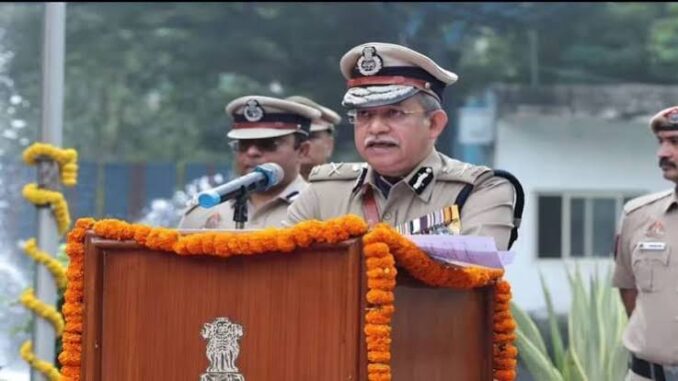
The Intelligence Bureau (IB) Special Director Anurag Kumar was appointed as Delhi police commissioner on Friday, but the sudden removal of Delhi Police Commissioner Satish Golcha and the appointment of his successor have triggered intense political debate, with multiple theories emerging over the reasons behind the unexpected change.
Sonam Wangchuk’s indefinite hunger strike or something else?
While the Opposition has alleged that the reshuffle was carried out to facilitate the arrest of climate activist Sonam Wangchuk ahead of his planned march to Parliament, sources familiar with the matter claim the leadership change may have been linked to an entirely different issue, the ongoing investigations into the Mahadev online betting app case.
The Ministry of Home Affairs (MHA) on Friday appointed 1994-batch IPS officer Anurag Kumar as the new Delhi Police Commissioner, replacing Satish Golcha with immediate effect. The abrupt nature of the decision surprised many within the police establishment.
According to accounts circulating in official circles, Golcha was attending a tree plantation programme with Delhi Lieutenant Governor VK. Saxena, when the order was issued.
The sudden change caught officials off guard
Sources claimed that the Delhi Police headquarters had little advance notice of the transition, forcing officials to quickly reorganise the ceremonial handover. As a result, Kumar was reportedly taken first to the Commissioner’s Secretariat before receiving the customary guard of honour.
The sudden change immediately sparked speculation over what may have prompted the Centre to replace the police chief.
Three major theories gained traction. The first linked the move to Sonam Wangchuk’s hunger strike, the second pointed towards corruption-related issues, while the third centred on the Mahadev online betting app investigation.
According to sources, the Mahadev betting app angle is being viewed in some quarters as the most significant factor behind the leadership change. They claimed that Satish Golcha’s name had allegedly surfaced in connection with certain individuals associated with the Mahadev betting app network, including promoter Saurabh Chandrakar and his close associates. However, no official agency has publicly confirmed these claims, and no formal statement from the Ministry of Home Affairs has linked Golcha’s transfer to the Mahadev investigation.
Opposition claims Wangchuk’s protest caused the sudden change
Meanwhile, the political narrative surrounding the reshuffle intensified after Aam Aadmi Party (AAP) Rajya Sabha MP Sanjay Singh accused Prime Minister Narendra Modi of replacing the Delhi Police Commissioner to ensure the arrest of Sonam Wangchuk before his proposed march to Parliament on July 20.
In a video message, Singh alleged that the 59-year-old climate activist, who had been on a 21-day hunger strike over alleged examination irregularities, including the NEET paper leak controversy, had become a powerful voice for lakhs of students affected by paper leaks.
“The Prime Minister knew this movement would gather momentum. Therefore, he changed the Delhi Police Commissioner and appointed someone who would arrest Sonam Wangchuk,” Singh alleged. He further claimed that Wangchuk was forcibly removed from Jantar Mantar and shifted to Safdarjung Hospital just days before his planned Parliament march.
The Opposition also accused the government of ignoring Wangchuk despite his prolonged fast. Singh alleged that neither the Prime Minister nor any senior government representative had attempted to engage with the activist during his 21-day protest. Similar criticism came from Samajwadi Party spokesperson Dr Ashutosh Verma, who claimed that removing Wangchuk ahead of the July 20 mobilisation reflected a government uncomfortable with growing public support for the protest.
The police action drew criticism from several Opposition leaders, including AAP’s Manish Sisodia, Saurabh Bharadwaj, Trinamool Congress MP Sagarika Ghose and Samajwadi Party MP Dimple Yadav, all of whom accused the government of suppressing peaceful democratic protests.
Delhi Police, however, rejected allegations of political interference. Officials said Wangchuk was shifted to Safdarjung Hospital strictly in compliance with directions issued by the Delhi High Court and on medical advice after his health deteriorated. According to police, protesters attempted to obstruct the medical transfer, resulting in minor commotion, but officers exercised “maximum restraint” throughout the operation.
DCP New Delhi Sachin Sharma later confirmed that Wangchuk had been admitted to a government hospital for medical intervention and remained under continuous medical supervision. Hospital sources said he is conscious, his vital parameters are stable, and he continues to be monitored in the emergency ward.
Adding another dimension to the controversy, Cockroach Janta Party (CJP) founder Abhijeet Dipke alleged that police forcibly dragged Wangchuk away from the protest site and assaulted him while he tried to intervene. CJP spokesperson Saurav Das also claimed that students gathered at Jantar Mantar were lathi-charged. These allegations, however, have not received any immediate official response from Delhi Police.
Dipke also announced that the group’s demands had expanded beyond seeking the resignation of Union Education Minister Dharmendra Pradhan over the alleged examination irregularities. Following Wangchuk’s removal, the organisation said it would now also demand Prime Minister Narendra Modi’s resignation and continue with its planned march to Parliament on July 20.
With no official explanation yet offered for the sudden replacement of the Delhi Police Commissioner, speculation continues to dominate the political discourse. While the Opposition sees the reshuffle as part of the government’s response to Wangchuk’s protest, separate claims linking the move to the Mahadev betting app investigation remain unverified.
Until authorities provide a formal clarification, the reasons behind one of Delhi Police’s most abrupt leadership changes in recent years are likely to remain the subject of intense public and political scrutiny.
Bureau Report
Leave a Reply