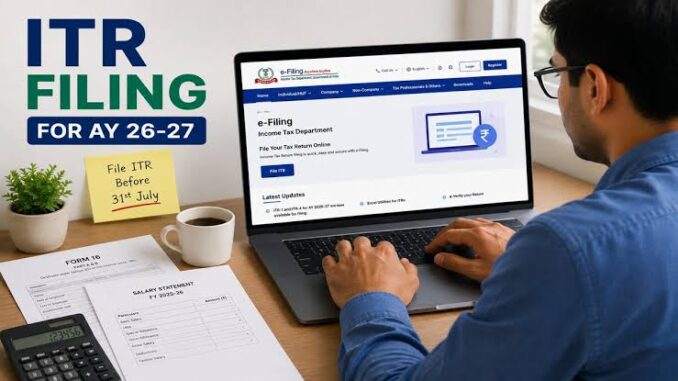
NewDelhi: As the Assessment Year 2026-27 filing season is underway, some retirees frequently wonder if they should file an Income Tax Return (ITR) even if they don’t have any tax liability. The answer is yes. Even if the tax liability is zero, filing an ITR is a smart decision because it can provide several financial and legal benefits.
Income tax slabs for senior citizens under old and new tax regime
Before deciding to skip return for the AY 2026-27, retirees should consider the income tax slabs for senior citizens under the old and new tax regimes.
For senior citizens (aged 60–79 years)
Income tax slab (old regime): upto Rs 3,00,000
Income tax rate: nil
Income tax slab (new regime): upto Rs 4,00,000
Income tax rate: nil
For super senior citizens
Income tax slab (old regime): upto Rs 5,00,000
Income tax rate: nil
Income tax slab (new regime): upto Rs 3,00,000
Income tax rate: nil
Under the default new regime, the tax-free limit is set at Rs 4 lakh while Section 87A rebates of Rs 60,000 effectively make income up to Rs 12 lakh tax-free. Under the old tax regime, resident senior citizens could get a tax rebate of up to Rs 12,500 if their net taxable income was less than Rs 5 lakh.
Key benefits of filing ITR for retirees even if tax liability is zero
Income tax submission and filing means retirees have a formal record of their annual income declaration to the IT department. Even in cases where the tax liability is zero, filing ITR for retirees helps to maintain a verifiable and factual financial history.
Income proof
An ITR acts as a legal document for senior citizens because it is recorded with the government. The ITR filed acts as income proof as it contains a detailed list of all the incomes and expenses of the retirees.
Applying for Loans
Several banks often request ITR documentation as proof of income while giving loans to customers. If senior citizens can produce a filed return to the banks or lending institutions then it can help improve eligibility for loans. A filed ITR return details the past and present financial position and assures loan repayment capability.
Claim refund
Tax deducted at source (TDS) might be deducted on savings interest, fixed deposits or dividend payouts for stocks even if tax liability is zero. Once the senior citizen files income tax returns, this helps them claim such a refund without any hassles. If excess tax has been deducted from income through TDS, filing an ITR becomes necessary to claim a refund.
Carry forward of losses
Senior citizens who have calculated losses from any source of income that cannot be offset against the current year’s income can carry forward these losses to future years by filing a tax return. Suppose a retiree has suffered losses in the stock market, property or business activity and wants to carry them forward to the next year, they can easily do so if they have filed an ITR.
Reconcile information appearing in AIS
Filing an ITR helps reconcile information appearing in the Annual Information Statement (AIS) and Form 26AS. This reduces the chances of future queries arising from reporting mismatches.
Claim benefits
Many senior citizens earn interest income, incur significant medical expenses or receive a pension alongside investment income. Filing an annual return helps them claim eligible benefits correctly.
Visa and immigration process
Several nations often request ITR records to assess financial stability and trustworthiness during visa clearance applications. A filed return helps show that the senior citizen has a regular source of income and a stable financial record.
Is there tax exemption for senior citizens?
Senior citizens are not generally exempt from filing ITR. However, under Section 194P of the Income Tax Act, senior citizens aged 75 and above are exempt from filing ITRs if they are resident individuals in the previous financial year, their only sources of income are pension and bank interest and both the pension and the interest are received from the same specified bank. Senior citizens who do not fulfill all the conditions under Section 194P must file ITR if their total income is above the basic exemption limit.
Applicable ITR forms for senior citizens
For senior citizens aged 60 and above, the ITR form depends on the source of income and not the age. Most senior citizens and pensioners file ITR-1 if the total income is up to Rs 50 lakhs and the income is derived primarily from pension, salary, one house property and other sources like bank interest. ITR-2 is used if you have income from capital gains, multiple house properties or foreign assets. ITR-3 and ITR-4 are used if you earn income from a business or profession.
Bureau Report
Leave a Reply