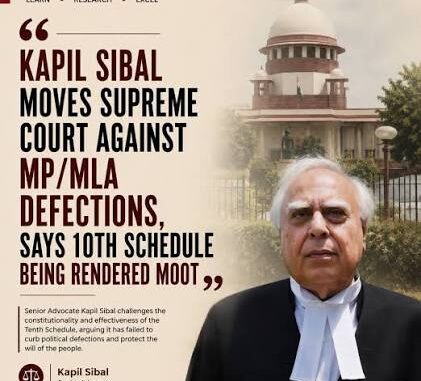
The Supreme Court’s decision to issue notice to the Centre on a Public Interest Litigation (PIL) filed by Senior Advocate Kapil Sibal brings back into sharp focus one of the most persistent vulnerabilities in Indian constitutional democracy: the circumvention of the anti-defection law through the ‘merger’ route. Sibal’s plea comes at a time when 20 Lok Sabha MPs from TMC, six from Sena-UBT and seven AAP Rajya Sabha MPs have shifted their allegiance to NDA. While the TMC MPs merged with the NCPI, the Sena-UBT MPs merged with the Sena-Shinde faction, and the AAP MPs joined the BJP. In all three cases, the two-thirds defections were shielded by the Paragraph 4 rule.
At its core, the petition challenges the claim that Paragraph 4 of the Tenth Schedule has allegedly transformed from a safeguard against political opportunism into a legal shield for engineered defections.
1. What is the Tenth Schedule to the Constitution?
Added via the Constitution (Fifty-Second Amendment) Act, 1985 during the tenure of then Prime Minister Rajiv Gandhi, the Tenth Schedule is popularly known as the Anti-Defection Law. Its primary objective was to combat the rampant, unprincipled political defections, a culture called ‘Aaya Ram, Gaya Ram’ in the politics of the late 1960s and 1970s, that destabilised democratically elected governments.
A. The Core Mechanism
The schedule lays down the process by which legislators (MPs and MLAs) can be disqualified for defecting. Disqualification is triggered if a member voluntarily gives up membership of their political party or votes (or abstains from voting) in the House contrary to the party’s whip.
B. ‘Split’ Exception & Constitutional Amendment
The law originally permitted ‘splits’, allowing a one-third chunk of a legislative party to break away without facing disqualification. However, recognising that this threshold invited continuous horse-trading and fractionalization, Parliament enacted the 91st Constitutional Amendment Act (2003). This amendment deleted the split exception and tightened the framework. The amendment mandated that a defection would only be excused if an entire party merged with another, provided that not less than two-thirds of the members of the legislative party agreed to the merger.
2. Why has Kapil Sibal Challenged its Interpretation?
Kapil Sibal’s petition argues that the 2/3rd merger provision (Paragraph 4) has been systematically weaponised to subvert the original intent of the law, effectively turning it into a ‘defectors’ paradise’. The primary grounds for his challenge include:
Inversion of the Electoral Mandate: Sibal contends that the current interpretation allows splinter groups to engineer artificial ‘mergers’ with rival parties, completely flipping an electoral majority into a minority (and vice-versa) post-election. In essence, the mandate given by the voters to a specific political party and ideology is discarded by a subset of legislators seeking power or protection.
The ‘Splinter Group’ Loophole: The grievance highlights how factions of lawmakers utilise the merger exception not because a true ideological merger of parent political organisations has occurred, but as a shortcut to bypass disqualification. When a 2/3rd subset aligns with an opposing camp, it is legally masked as a ‘legislative party merger’, insulating the defectors from penal consequences.
3. Supreme Court’s remarks
Confronting the structural flaws of India’s anti-defection framework, the Supreme Court observed on Monday that while the Tenth Schedule is riddled with “enormous issues,” its reform ultimately rests with the lawmakers who drafted it.
Presiding over a petition filed by Senior Advocate Kapil Sibal—which challenges the current interpretation of the law’s merger provisions—a Bench of Justices P.S. Narasimha and Alok Aradhe suggested that such systemic corrections should ideally originate on the floor of the House rather than through judicial intervention.
“Tenth Schedule is intended to regulate the mechanism between the legislators. We have [upheld] the Tenth Schedule. We have been seeing it. There are enormous issues with the Tenth Schedule. But who made it? It’s the making of the MPs,” the Bench said.
What’s next?
The Supreme Court will hear the arguments from both sides but while it may suggest reforms, the court is unlikely to strike down the Para 4 merger rule as it’s created by Parliament itself, say experts. The ultimate onus will fall on the legislature for the reforms and the judiciary might not interfere in this matter.
Bureau Report
Leave a Reply