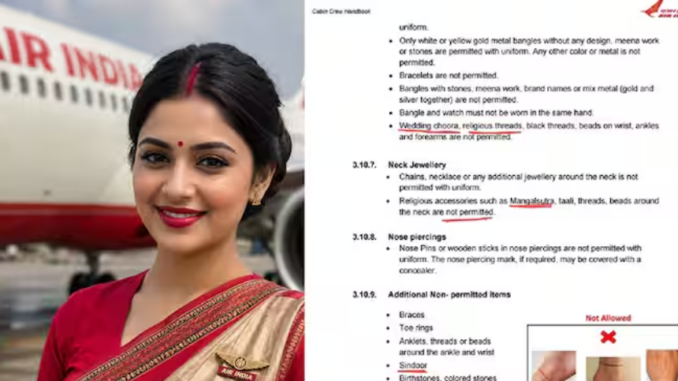
NewDelhi: The Lenskart store manual sparked a fire on social media, and its flames have just engulfed Air India. The airline is now facing the ire of social media users after its manual for cabin crew went viral. The social media users flagged that the manual prevents staff from wearing bindi, tilak, kalawa, and mangalsutra. The manual also bars staff from wearing black thread, nose pins, and anklets, among other items.
Social media outrage
The social media users alleged the distortion of Hindu culture and symbols. “Air India has no official hijab policy, but has a clear official ban on bindi, sindoor, tilak, and even mangalsutra,” wrote a user on X.
Another user posted, “It appears that this problem runs much deeper. Here are some pictures from the Air India Cabin Crew Handbook. Bindi, Sindoor, Tilak etc not allowed. Why are they doing this so blatantly?”
“One of the biggest flaws of the current legal system is that the habitual offenders who deliberately break the law know best how to misuse that very law for their own benefit,” added the user.
In a long post, another user said, “In A Nation As Deeply Hindu Civilizational As Republic India , Airlines Are Not Merely Transport Service Providers – They Are Flying Ambassadors Of Hindu Culture, Tradition & Identity. When Hindu Cultural Representation Is Diluted By All Airlines In The Name Of Global Standardisation, It Creates A Perception That Indigenous Values Are Secondary.”
Air India says ‘bindi’ a choice
Amid the outrage, Air India has clarified that the manual is an older version and staff have a choice to wear a bindi. ”Air India would like to clarify that its employees have the choice to wear a bindi. The images being circulated online are from an older manual that is no longer in use,” an Air India spokesperson told Zee News.
However, it’s assumed that sindoor, tilak, religious threads like kalawa and black threads remain barred as the airline did not issue any clarification over this.
Aviation expert defends manual
While the airline is facing social media anger, an aviation expert has defended the move, saying that the dress code is deeply aligned with the operations of airlines. The expert, who did not wish to be named due to the religious angle involved, said that many people think the dress codes in aviation are only about the way the crew looks, but that is not so.
“The uniforms are fundamental for operations, discipline and safety, especially at 35,000 ft above the land. The aviation industry functions within a framework of the standards established by international and national regulators, developed over decades of safety experience. Cabin crew carry significant responsibility, with every aspect of their role directly connected to in-flight operations, ensuring they can perform their duties with maximum efficiency,” said the expert.
The expert highlighted that these rules are made simply on the basis of safety and reducing the risk, leaving aside any cultural or religious elements.
“The aviation industry follows the principle of risk elimination. For example, loose accessories which could get entangled in the equipment should be avoided, and jewellery that could cause injury in turbulence or evacuation should be removed,” said the expert. He further added that cosmetics can interfere with the hygiene protocols and they should be restricted.
Critics agreed with the loose jewellery argument, but questioned how the sindoor or the tilak could interfere with the operations.
Bureau Report
Leave a Reply