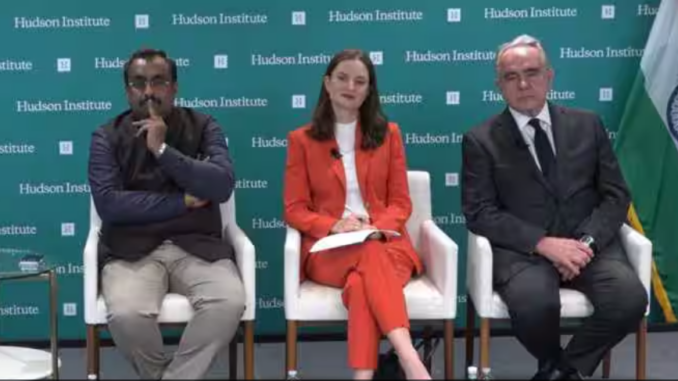
America: Former United States Deputy Secretary of State Kurt M Campbell on Thursday (local time) said that all of America’s strategic interests lie with India, not Pakistan. He also expressed concern over the current state of US-India ties, stressing that mutual respect remains a fundamental principle for the relationship from now on.
Speaking at the Hudson Institute, Campbell said, “We need absolute clarity on that. America’s future is with India, and Pakistan doesn’t even get close. I’m sorry if that offends anyone…It is troubling on some level that we have to have a reminder about mutual respect. I wouldn’t have thought that the US -India relationship would ever come to this point, but I acknowledge that we are here, and I do believe that, as a foundational principle, it is of critical importance.”
BJP leader Ram Madhav, who was also present at the dais, added, “When India did strategic autonomy, we were ridiculed and rubbished. But now look at what America is doing today. It is exactly strategic autonomy. So mutual respect and sensitivity are important…”
Moving further, Campbell added that India was the leading force behind the Quad grouping, highlighting its key role in shaping the partnership among the four countries.
“… We have to acknowledge that during the first Trump administration, it was the decision by key players in the administration to provide on an urgent basis information, intelligence, and others to Indian friends at a moment of real peril along the line of actual control…I was there, despite whatever reports I watched, President Biden persuaded, over an hour, a very reluctant Prime Minister Modi to join the Quad at the leader level. Like literally fought him to an agreement to the point where he said, ‘I promise I will do this if you just stop haranguing me’… The leading nation behind the scenes in the Quad was not the United States. It was not Australia. It was not Japan. It was India,” he said.
Pakistan-US Ties on rise: What it means for India
Relations between Washington and Islamabad have been warming considerably, a shift that has not gone unnoticed in New Delhi.
The thaw began gathering pace in the aftermath of Operation Sindoor, India’s military response to the Pahalgam attack of April 2025. Donald Trump later claimed credit for brokering a ceasefire between the two South Asian neighbours following four days of conflict in May. India, however, firmly rejected that version of events, maintaining that the ceasefire was the result of direct military-to-military communication between New Delhi and Islamabad, with no American hand in it.
Since then, Pakistani Prime Minister Shehbaz Sharif and army chief General Asim Munir have made repeated trips to Washington, holding talks with President Trump on a range of bilateral and regional matters.
Playing mediator between the US and Iran
Pakistan has also stepped into a far more delicate role. Since a US-Iran conflict broke out in February 2026, Islamabad has been quietly facilitating indirect talks between the two sides. A fragile two-week ceasefire has held so far, with the first round of negotiations having already taken place in Islamabad and a second round in the pipeline. Both Sharif and Munir have been directly involved in efforts to coax the parties towards something more durable.
Minerals, money and a strategic opening
A notable moment in this renewed relationship came in September 2025, when PM Sharif and General Munir arrived at the White House carrying samples of Pakistani rare earth minerals. The gesture was deliberate, Islamabad was making a pitch for American investment in its estimated $6 trillion worth of mineral reserves, concentrated largely in Balochistan and Khyber Pakhtunkhwa.
The courtship appears to have borne fruit. A deal has since taken shape, backed by an initial $500 million from USSM, structured across three phases: the first covering the immediate export of available minerals such as antimony and copper concentrates to American markets; the second focused on building processing plants and refineries within Pakistan between 2026 and 2028; and the third envisaging large-scale mining operations from 2028 onwards. Pakistan has already dispatched its first consignment of mineral samples to the United States, edging the arrangement closer to implementation.
For Washington, the appeal is straightforward, reducing dependence on China for critical minerals. For Islamabad, it is an opportunity to recast itself as a strategic partner rather than a problem state.
New Delhi watches with unease
It is against this backdrop that former US Ambassador to India Kenneth Juster offered a candid assessment this week, warning that Pakistan’s growing closeness with Washington carries real consequences for India.
Juster described Islamabad’s diplomatic gains as “Pakistan’s successful courting of the Trump administration,” adding that it “now extends to being an intermediary in the US-Iran talks.” He was direct about how this registers in Indian circles, “Obviously, on multiple levels and for many reasons, this is an irritant to India and a surprise to many of us.”
Beyond the symbolism, he suggested the shift could shape India’s choices in a very practical sense. Drawing on his own experience during the Pulwama attack and the subsequent Balakot air strikes, Juster observed that India’s willingness to mount a forceful response to cross-border terrorism may now be tempered by uncertainty over where Washington stands.
India, he said, “may have doubts as to whether the United States will support a muscular response” to militant groups operating out of Pakistani soil, a pointed remark given the history between the two neighbours.
That said, Juster was equally clear that the US-India relationship remains of fundamental importance, and called on both sides to deepen their partnership in ways that serve their mutual interests.
Bureau Report
Leave a Reply