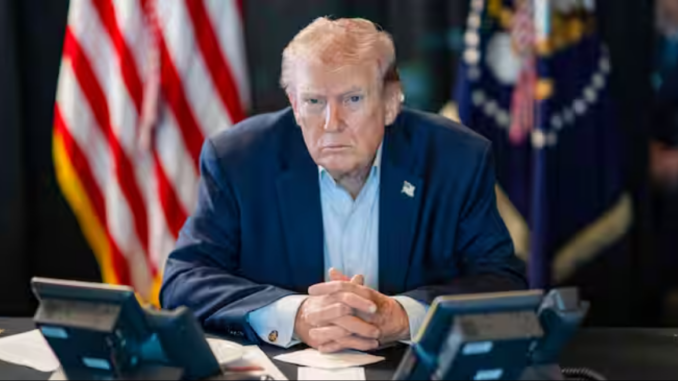
Tehran: US President Donald Trump may have extended the ceasefire with Iran, but a far more uncomfortable deadline is closing in, and this one is not coming from Tehran. It is coming from his own Congress. Under the War Powers Resolution, a federal law passed in 1973 to limit a president’s authority to wage war without legislative backing, Trump has until 1 May to secure Congressional approval for continued military operations against Iran. If that approval is not granted, the law requires him to halt those operations. Whether he will comply is another matter entirely.
What the War Powers Resolution actually says
The 1973 law was designed specifically to prevent American presidents from dragging the country into prolonged conflicts without the consent of its elected representatives. Under its provisions, a president must inform Congress within 48 hours of initiating military action and may sustain deployments for no more than 60 days, with a single 30-day extension possible, unless Congress passes a formal authorisation for a longer commitment. Both the House of Representatives and the Senate must approve such authorisation by a simple majority.
That authorisation has not materialised. And given the current state of play in Congress, it is far from guaranteed.
A divided Congress, an uncertain vote
The divisions on Capitol Hill over the Iran conflict run deep. On 15 April, a bipartisan effort in the Senate to invoke the War Powers Resolution and curtail Trump’s military authority was defeated by 52 votes to 47, with members voting largely along party lines.
Democrat Senator Chris Murphy did not hide his frustration. “We should not fail to note how extraordinary it is that our Senate Republican leadership has declined to do any oversight of a war that is costing billions of dollars every week,” he said.
Republican senators have, for the most part, declined to challenge the president during the 60-day window, but several have made clear that their patience has limits. Senator John Curtis put his position in writing, “I support the president’s actions taken in defence of American lives and interests. However, I will not support ongoing military action beyond a 60-day window without congressional approval. I take this position for two reasons, one is historical, and one is constitutional.”
Republican Congressman Don Bacon was equally direct. “By law, we’ve got to approve continued operations or stop. If it’s not approved by law, they have to stop their operations,” he told US media.
Has the ceasefire actually held?
In practice, the ceasefire announced on 8 April has been far from clean. While Trump declared a unilateral extension earlier this week without specifying a deadline for resumed talks, military pressure on Iran has continued in the background.
On Monday, US forces fired on and seized the Iranian-flagged container ship Touska in the northern Arabian Sea near the Strait of Hormuz, after the vessel reportedly ignored American orders to alter its course. The incident followed Washington’s imposition of a naval blockade on all Iranian ports on 13 April.
Iran responded two days later by capturing two foreign commercial vessels in the Strait of Hormuz. The Reuters news agency subsequently reported that the US military had intercepted at least three Iranian-flagged tankers in Asian waters, reportedly redirecting them from positions near India, Malaysia and Sri Lanka.
Will Trump simply ignore the deadline?
Analysts believe Trump is unlikely to walk away from the conflict cleanly, even if Congress withholds approval. The war has been damaging for him politically; polls consistently show the American public is opposed to it, but retreat would mean accepting defeat, something that sits uneasily with his instincts.
There are also legal avenues he could explore. The Authorisation for Use of Military Force, first passed after the September 11 attacks in 2001 and again in 2002 to authorise the invasion of Iraq, grants the president authority to use force for specific purposes and has been used by successive administrations as a basis for military action without fresh congressional approval. In his first term, Trump himself used the 2002 authorisation to order the killing of Iranian General Qassem Soleimani in Baghdad in 2020.
A well-worn path around Congress
American presidents have a long history of finding ways around the War Powers Resolution. Bill Clinton conducted military operations in Iraq, Somalia and Yugoslavia during the 1990s without congressional authorisation. His 79-day campaign against the former Yugoslavia in 1999 survived a legal challenge brought by former Congressman Tom Campbell and 17 others, who argued it violated the War Powers Act. The courts did not rule in their favour.
The Obama administration took a different approach during the 2011 Libya campaign, arguing that the mission did not constitute “hostilities” under the legal definition of the War Powers Resolution, and therefore required no congressional sign-off. That interpretation was contentious, but it held.
Trump, with 1 May approaching and no clear path to congressional approval, may well be weighing similar options. The deadline is real. Whether it proves binding is a question that American democracy may soon have to answer.
Bureau Report
Leave a Reply