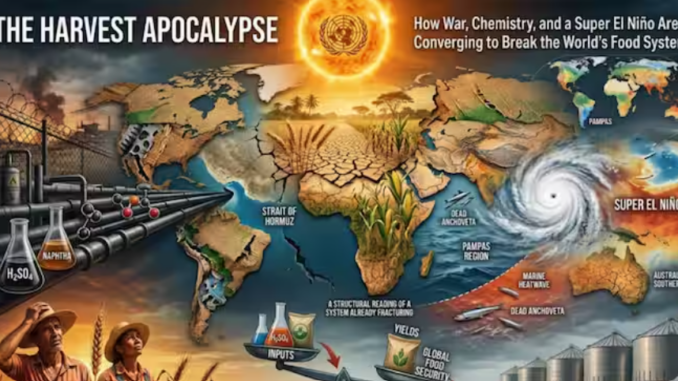
NewDelhi: The world is sleepwalking into a food crisis of historic proportions. Not because of any single failure, but because three catastrophic forces, an extreme heat emergency formally documented by the United Nations, a wartime chokepoint strangling the chemistry that feeds the planet, and a super El Nino bearing down on the world’s most vulnerable agricultural basins, are arriving simultaneously, and amplifying each other with brutal precision. What follows is not a forecast. It is a structural reading of a system already fracturing at multiple points.
The UN’s verdict: Heat is baseline risk
The Food and Agriculture Organisation (FAO) and the World Meteorological Organisation (WMO) delivered a landmark joint warning in April 2026: extreme heat has become the defining threat to global food security. Their findings are stark. Crop yields begin declining above 30°C; livestock suffer heat stress beyond 25°C. A single heatwave can slash agricultural productivity by up to 50 per cent. In 2024, 91 percent of the global ocean experienced at least one marine heatwave, undermining fisheries at scale. Agricultural workers, the FAO notes, are 35 times more likely to die from heat exposure than workers in other sectors.
In South Asia, tropical sub-Saharan Africa, and Central America, the number of days annually that are too dangerous to work outdoors could rise to 250 by mid-century. For every additional degree Celsius of warming, yields of staple crops such as maize and wheat are projected to fall by 4 to 10 percent. These are not projections about a distant future. The trajectory is already locked in, and 2026 is where the acceleration becomes visceral.
Chemical chokepoint no one is talking about
What the UN report cannot fully capture is the industrial trap now closing around the world’s farmers. Modern agriculture does not run on sunlight and soil alone. It runs on sulphuric acid, naphtha, and the continuous molecular assembly line of synthetic crop protection chemistry.
Sulphuric acid is the upstream key to phosphate fertiliser production, roughly 45 percent of global consumption goes directly to producing phosphoric acid for phosphate inputs. That supply chain now faces a dual collapse. The near-total closure of the Strait of Hormuz, which handles approximately 49 to 50 per cent of global seaborne sulphur flows, has effectively cut the feedstock artery. Simultaneously, China has mandated a halt on all smelter-by-product sulphuric acid exports from May 2026, removing approximately 4.65 million metric tonnes, roughly 15 per cent of global seaborne supply, in a single political decree designed to protect its own agricultural output.
India, with domestic sulphuric acid demand exceeding 20 million tonnes annually, has instituted its own prioritisation framework for domestic fertiliser producers. The result is a ruthless geopolitical allocation: food-security fertilisers come first; critical mineral mining, copper in the DRC, nickel in Indonesia, uranium in Kazakhstan, gets whatever is left.
US domestic sulphur prices have already surged 165 percent year-on-year to over $650 per metric tonne. FAO data shows granular urea in the Middle East spiked 19 percent in a single week in March 2026, while Egyptian urea surged 28 percent.
Why crops cannot simply cope
A widespread misconception is that drought-stressed crops need less fertiliser. The agricultural chemistry tells the opposite story. Under heat and water stress, crops require highly specific “survival nutrients”, phosphorus to drive deep root growth, and potassium to regulate leaf pore closure and prevent cellular dehydration. These nutrients are locked inside rock and only become plant-accessible through dissolution in sulphuric acid. Cut the acid, and the plant’s internal defence mechanisms are stripped away precisely when the climate demands them most.
The naphtha dimension is equally catastrophic and less understood. While sulphur feeds the crops, naphtha protects them. Roughly 1.2 million barrels per day of naphtha transit the Strait of Hormuz, the molecular feedstock for benzene, toluene, and xylene, the chemical backbone of every major herbicide, insecticide, and fungicide in commercial use. Without these compounds, modern monoculture reverts to ecological open warfare: crops bred for chemical-assisted productivity are structurally defenceless without them. Research-based yield-loss baselines are devastating, 34 per cent to weeds, 18 per cent to insect pests, 16 per cent to pathogens. For maize alone, that translates to the destruction of over 553 million metric tonnes of output. The caloric math resolves to approximately 3,790 trillion kilocalories lost, the annual energy requirement of roughly 3.79 billion people.
El Nino arrives as the synchronising shock
Into this compromised system arrives the climate event that meteorological consensus has been warning about. The NOAA Climate Prediction Centre, the International Research Institute for Climate and Society, and the ECMWF collectively place the probability of an El Nino event developing between May and July 2026 at 75 percent. Early atmospheric teleconnections carry the hallmarks of the strongest El Nino since 1877–78. The WMO confirms the characteristic geography: severe drought across Australia, Indonesia, and southern Asia; catastrophic flooding across parts of South America’s Pampas; and disrupted planting calendars across South Asia, Latin America, and southern Africa.
The interaction with the chemical shortage is multiplicative, not additive. El Nino imposes biological stress precisely when agrochemical protection has been stripped away. In drought zones, applied fertilisers cannot dissolve without soil moisture, expensive inputs become inaccessible chemical deposits in dry topsoil. In flood zones, heavy rainfall flushes nitrogen and phosphate from the root zone before uptake occurs. The Panama Canal, handling 29 per cent of US soybean exports and 91 per cent of US sorghum exports, faces severe transit restrictions if El Nino reduces Gatun Lake water levels as projected, a replay and likely intensification of the 2023–24 drought that reduced daily transits to just 24 vessels.
Peru’s fisheries regulator has already cut the 2026 North-Central anchoveta catch allowance by 36 per cent in response to warming coastal waters, collapsing the global fishmeal supply that underpins livestock protein and organic fertiliser markets simultaneously.
Who bears the brunt
why: “They control the rock, the acid, and the logistics.”
The asymmetric damage mapping is clear. Vertically integrated producers, Morocco’s OCP Group controlling the full phosphate chain, The Mosaic Company anchoring North American and Brazilian supply, will capture historic margin premiums. Nations with captive supply are being transformed into agricultural superpowers by default.
The catastrophic losers are import-dependent economies with no buffer. Egypt, Pakistan, Indonesia, and the Philippines face balance-of-payments crises in the literal sense: soaring grain prices, currency depreciation against a strong dollar, depleted foreign reserves, and the mathematical impossibility of purchasing sufficient food in a market defined by physical scarcity. West and Central Africa, where over 52 million people already face acute food insecurity, stares at local harvest failures with no affordable inputs and no financial headroom.
The WFP warns the compounding shocks could push an additional 45 million people into acute hunger by mid-2026. Agricultural economists tracking soil nutrient depletion note that under-application in 2026 will mechanically suppress global yields through 2028–2030, regardless of whether conditions normalise, a structural hangover baked in before this crisis has even peaked.
The systemic verdict
What distinguishes this polycrisis from prior food shocks is its near-perfect synchronisation. The 1973 oil embargo, the 2007–08 food price spike, the 2010 Russian wheat export ban, each was severe but sequential. This convergence is simultaneous: a wartime chokepoint severing chemical inputs, a sovereign export ban compressing what remains, and a super El Nino imposing biological stress on crops whose chemical defences have already been removed.
The FAO and WMO are correct in calling for heat-resilient crop varieties, early warning systems, and international solidarity. But those recommendations presuppose input access, functioning logistics, and solvent fiscal positions across the countries most exposed. In 2026, all three are in serious jeopardy at once.
The harvest is at risk. The chemistry that enables it is being rationed by war and statecraft. And the weather is about to make the worst possible timing even worse.
Bureau Report
Leave a Reply