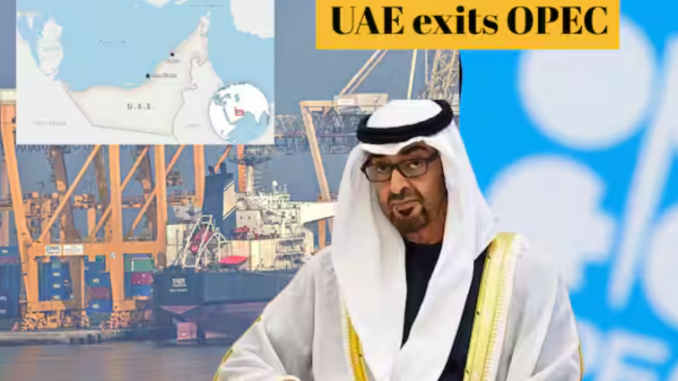
Abu Dhabi: UAE exits OPEC: The United Arab Emirates has walked out of OPEC after 59 years, and the reasons stretch well beyond oil quotas. Behind Tuesday’s landmark decision lies a chain of events rooted in war, betrayal and a deepening rift between Abu Dhabi and the Pakistan-Saudi Arabia axis that has been quietly taking shape across the Gulf.
When the US-Iran conflict broke out, the UAE found itself on the front line. After the United States and Israel initiated strikes against Tehran, Iran directed much of its retaliation at the UAE infrastructure. By April 8, Abu Dhabi’s Ministry of Defence had intercepted 537 ballistic missiles, 26 cruise missiles and 2,256 drones. The scale of the assault left the UAE militarily battered and politically furious.
The Iranian attacks that left UAE exposed
What made it worse was what happened next. President Donald Trump declared a unilateral ceasefire, effectively stepping back from the conflict, and used Pakistan as the intermediary to facilitate indirect US-Iran talks. For the UAE, which had wanted a harder response against Tehran, Pakistan’s role as mediator was a direct affront. Abu Dhabi had reportedly signalled to Islamabad that it wanted Pakistan to take a firmer line against Iran. Islamabad ignored that message entirely and positioned itself as a neutral broker instead.
“They sought to position themselves as a mediator, which didn’t go down well,” one report noted. For the UAE, there was no middle ground in this conflict. Pakistan had chosen one.
The loan recall that signalled a break
The frustration translated quickly into financial pressure. The UAE demanded immediate repayment of a $3.5 billion loan it had extended to Pakistan, a demand it had not been expected to make until the end of 2027. The recall wiped out roughly a fifth of Pakistan’s central bank liquidity in one stroke.
Saudi Arabia stepped in to cushion the blow, lending Pakistan $3 billion and promising a further $5 billion line of credit. The move underlined how firmly Riyadh and Islamabad are now aligned, and how clearly the UAE sits on the other side of that relationship.
The two countries had formalised that alignment in September 2025, signing a mutual defence agreement whose full details remain undisclosed. What is known is that the arrangement, described as NATO-like in structure, allows Pakistan to provide nuclear weapons and missiles in defence of Riyadh. Pakistan is the only Islamic country with nuclear weapons.
A Gulf already divided
The UAE’s discomfort with the Saudi-Pakistan-Turkey axis did not emerge overnight. The two Gulf powers have been pulling in opposite directions for years across multiple theatres.
In Yemen, Saudi Arabia and the UAE were partners in the 2015 intervention but have repeatedly clashed over strategy since. Riyadh has pushed for political accommodation with the Houthis, while Abu Dhabi has backed southern separatists and adopted a more confrontational posture towards Iranian-backed groups. Those differences have strained their alliance significantly since 2019.
In Sudan, the divide is equally sharp. Since the 2023 civil war, the UAE has been widely accused of backing the paramilitary Rapid Support Forces, while Saudi Arabia, aligned with Egypt, has supported the Sudanese Armed Forces. The rivalry over influence, Red Sea ports and resources has turned Sudan into yet another arena of Gulf competition.
The OPEC exit and what it means
Against this backdrop, the UAE’s decision to leave OPEC carries significance that goes well beyond energy policy. For decades, Saudi Arabia has been OPEC’s undisputed leader, setting production quotas and directing the group’s overall strategy. The UAE’s departure removes one of the cartel’s top three producers, the country pumps around three million barrels per day, accounting for roughly nine per cent of OPEC’s total output, at a moment when the organisation is already under strain from the US-Iran conflict and disruptions around the Strait of Hormuz.
Freed from quota restrictions, the UAE can now pump at full capacity, a move that analysts describe as both an economic gain and a pointed assertion of independence from Riyadh. The UAE’s decision to exit from OPEC reflects a policy-driven evolution aligned with long-term market fundamentals. Abu Dhabi is no longer willing to subordinate its interests to Saudi leadership, either inside OPEC or in the wider region.
The exit does not mean a complete rupture. The two countries remain major trading partners and fellow members of the Gulf Cooperation Council. But after 59 years inside the same oil cartel, the UAE has chosen this particular moment, amid war, blockade and shifting alliances, to step out of Saudi Arabia’s shadow in the most visible forum available to it.
Whether this marks the beginning of a lasting realignment in Gulf politics or a calculated short-term move remains to be seen. What is no longer in doubt is that the UAE has picked a side, and it is not the one Islamabad and Riyadh are on.
Bureau Report
Leave a Reply