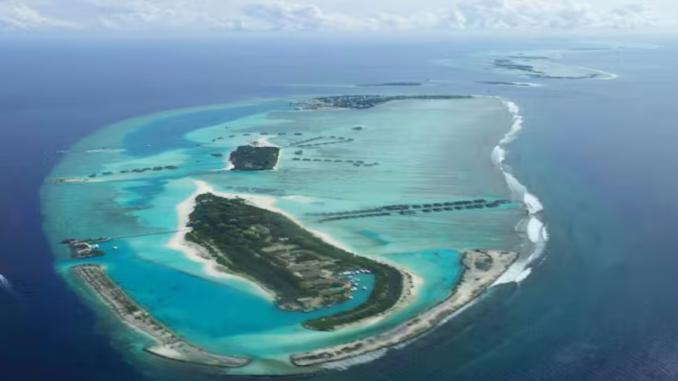
NewDelhi: As tensions continue to rise around the Strait of Hormuz, India is moving faster on plans to strengthen both civilian and military infrastructure in Lakshadweep. A major part of this plan is the proposed dual-purpose airfield on Minicoy Island, which defence planners see as a major strategic asset for monitoring the Arabian Sea and the wider Indian Ocean region.
These developments have once again underlined India’s expanding interest in island territories located close to some of the world’s busiest maritime trade routes.
Prime Minister Narendra Modi had earlier visited Lakshadweep and shared videos and photographs of himself snorkeling in the islands’ waters. He had encouraged Indians to explore the islands and experience adventure tourism there.
China’s expanding presence raises strategic concerns
Indian strategic experts look at Lakshadweep through a security lens because of China’s growing presence across the Indian Ocean region.
Over the past few decades, Beijing has invested heavily in ports and infrastructure projects in countries around India’s maritime neighbourhood. Chinese involvement in the Hambantota Port project in Sri Lanka is cited as one of the biggest strategic concerns for India. The port lies around 300 kilometres from India.
China has also expanded its footprint in the Maldives and is involved in infrastructure and airport projects on several islands there.
Strategic experts say that ports such as Chennai, Kochi and Visakhapatnam lie roughly 900 to 1,500 kilometres from Hambantota. India’s Satish Dhawan Space Centre is also located nearly 1,100 kilometres away.
Against this backdrop, Lakshadweep has become increasingly important for India’s naval planning and maritime surveillance efforts.
Minicoy airfield – A military-civilian project
India’s strategy for Lakshadweep is now moving ahead with plans to establish a dual-use airfield on Minicoy Island. Government sources say the project is designed to support both military aircraft, including fighter jets and civilian commercial flights.
Officials see the project as a strategic step that could improve military operations as well as civilian connectivity in the region.
The cooperation between the Indian Coast Guard and the Indian Air Force is expected to play a major role in the project. The Coast Guard had initially recommended the development of an airfield in Minicoy because of the island’s strategic location.
Military planners believe the proposed runway could strengthen India’s surveillance capabilities across the Arabian Sea and large parts of the Indian Ocean. Defence experts also say the project gains importance as China continues expanding its presence in the region.
Lakshadweep’s growing strategic role
Indian officials are now examining how Lakshadweep can help counter the strategic impact of China’s growing ties with countries such as the Maldives, Mauritius, Seychelles, Sri Lanka, Myanmar and Pakistan.
Experts argue that India should not only secure these islands but also develop them as strategic strong points. Their geographical position gives the country a tactical advantage during periods of conflict or heightened regional tension.
The strategic value of Lakshadweep also became more visible on April 7, 2021, when the guided missile destroyer USS John Paul Jones sailed near the Lakshadweep coast. Analysts said the incident highlighted how major international powers are increasingly interested in building military, diplomatic and political influence in the Indian Ocean region.
Lakshadweep is also seen as important for naval operations, anti-smuggling activities and maritime security.
Security agencies believe the islands could be used as monitoring points against the movement of weapons, narcotics and pirate vessels across the Arabian Sea. The islands are also located close to the Nine Degree Channel, one of the fastest and busiest sea routes that connect West Asia with East Asia.
Defence experts say the channel can be effectively monitored from Lakshadweep, giving India a stronger position in maritime surveillance.
Arabian Sea becoming a strategic centre
The Arabian Sea connects several countries, including Yemen, Oman, Pakistan, Iran and the Maldives. It also links many of the world’s busiest shipping routes and ports, making it one of the most important maritime trade regions across the world.
Leave a Reply