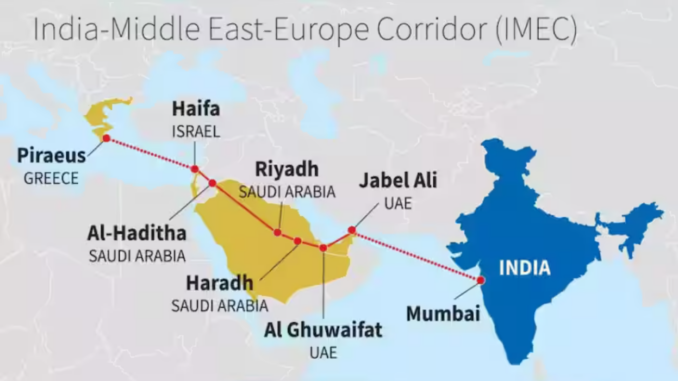
Europe: With the conflict in West Asia disrupting key maritime routes through the Strait of Hormuz, India’s ambitious trade corridor strategy has become a high-stakes geopolitical balancing act. Flexible and diversified supply chains are no longer optional but essential for national economic security.
The India-Middle East-Europe Economic Corridor
Launched at the 2023 G20 Summit in New Delhi, it is rapidly taking shape as a game-changing east-west trade artery. The corridor connects Indian ports directly to the UAE, Saudi Arabia, Jordan, and Israel before linking to European markets through efficient rail and sea routes.
It promises to slash transit times by up to 40% compared to the Suez Canal route while offering lower costs and enhanced security. India is outpacing competitors through deep strategic partnerships with Gulf monarchies and Israel, including recent MoUs on green hydrogen, digital payments, and port modernization. This positions New Delhi as a central hub in West Asian logistics and diminishes potential over-reliance on any single external power.
International North-South Transport Corridor
Further strengthening its northern outreach, the International North-South Transport Corridor (INSTC) is a 7,200-kilometre multimodal network connecting India’s western ports through Iran and the Caspian Sea to Russia, Central Asia, and onward to Northern Europe via sea, rail, and road.
Originally signed in 2000 between Russia, India, and Iran, the corridor now has more than 14 members and transit partners. It features three arms, a western route via Azerbaijan, a central trans-Caspian route, and an eastern route running through Kazakhstan and Turkmenistan. Despite geopolitical complexities, India has invested in key infrastructure and coordinated with partners to operationalize segments, dramatically cutting transit times and costs compared to the traditional Suez route while building a more sanctions-resilient northern trade gateway.
India-Myanmar-Thailand Trilateral Highway
In Southeast Asia, the India-Myanmar-Thailand Trilateral Highway is steadily progressing, creating a vital land bridge from India’s northeastern states through Myanmar to Thailand and beyond into ASEAN markets. Expected to be fully operational by 2027 with 70% work completed, this flagship project under India’s Act East Policy directly counters Chinese dominance in overland connectivity in the region.
Indian construction companies are actively executing road segments. In October 2025, the NHAI reported the completion of Phase-1 of the Yargi–Kalewa section. New Delhi provides capacity-building support in customs harmonization and logistics. By offering seamless access to growing ASEAN economies, the highway allows India to expand its trade footprint and helps partner countries diversify away from concentrated external dependencies, fostering greater regional economic balance.
Kaladan Multi-Modal Transit Transport Project
The Kaladan Multi-Modal Transit Transport Project, expected to be operational by 2027, serves as a crucial complementary initiative, linking Kolkata Port by sea to Myanmar’s Sittwe Port and then connecting via river and road to India’s landlocked Mizoram state. This alternative route significantly reduces dependence on the vulnerable Siliguri Corridor or the Chicken’s Neck for northeastern connectivity.
India has accelerated port development and inland navigation components in recent years, providing faster and more reliable access for goods and people. The project not only enhances strategic autonomy for India’s northeast but also positions Indian infrastructure expertise as a reliable alternative to larger but often slower-delivered initiatives by other powers in the Bay of Bengal region.
Mekong-India Economic Corridor
The Mekong-India Economic Corridor (MIEC) is not a fully functional trade route as of now, but it aims to deepen integration with the dynamic Mekong sub-region encompassing Cambodia, Laos, Myanmar, Thailand, and Vietnam. Through enhanced sea, road, air, and digital linkages, MIEC focuses on high-value sectors such as electronics, agriculture, tourism, and renewable energy.
Indian diplomacy has intensified engagements with Mekong nations on skill development, green technology transfer, and supply chain collaboration. This corridor effectively balances regional influence by presenting a collaborative model that prioritizes sustainability and inclusive growth, further solidifying India’s emergence as a key architect of resilient Indo-Pacific trade networks.
Leave a Reply