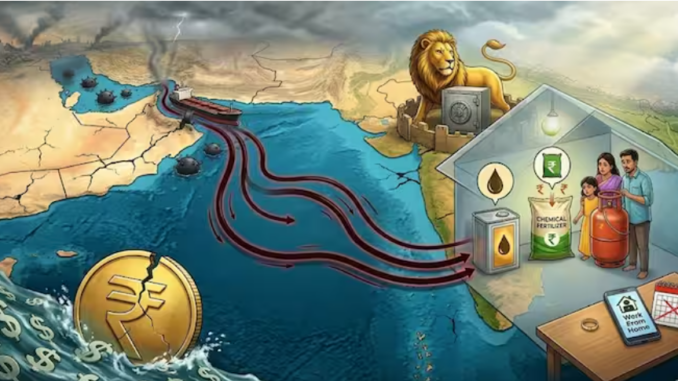
NewDelhi: Think twice before you top up your tank or pick up that gold ring. With India’s forex reserves dipping by over $7 billion in a single week, gold prices touching Rs 1.5 lakh and fuel costs under pressure, even the smallest purchase sends vital US dollars flowing out of the country, draining India’s foreign exchange reserve. Prime Minister Narendra Modi’s recent appeal to defer gold buying and curb fuel use isn’t just political rhetoric; it is a direct warning about the economic threats looming over every Indian household. Prime Minister Modi’s call was for a ‘Civilian Defence’ against a global economic shock amid West Asia tension. So, if you are wondering why the Government wants you to exercise caution, here is a detailed explanation:
1. The ‘Dollar Drain’
India’s economy is currently facing a ‘double-whammy’ of rising prices and high demand. In fiscal year 2025-26, gold and fuel have become the primary drivers of India’s trade deficit. Due to the recent LPG crisis, the prices of daily food items have already gone up. In 2025-26, India’s gold imports surged 24% to a record $71.98 billion. Even though people bought less gold by weight, the skyrocketing global prices, currently around Rs 1,56,000 per 10gms, meant India had to send significantly more US dollars abroad. Not only this, India imports roughly 89% of its crude oil needs. With the West Asia war causing supply disruptions as the Strait of Hormuz remains choked, the oil import bill for FY25 reached $143 billion. Every litre of petrol saved is essentially a few more cents kept in India.
2. The WFH and Fuel Connection
PM Modi’s push to revive ‘Covid-era efficiency” (WFH and car-pooling) isn’t just about traffic; it’s about Foreign Exchange Preservation. Transportation fuels (petrol and diesel) account for 59% of India’s total fuel consumption. By shifting meetings to virtual platforms, the nation reduces the daily burn of millions of litres of fuel. This ‘digital conservation’ acts as a direct shield against the volatility of Brent crude prices, which have been shaken by the regional conflict.
3. ‘Kitchen Economics’
PM Modi also highlighted ‘kitchen economics’ – edible oil and fertilisers, which often go unnoticed by the average consumer.
| Category | Import Dependency | 2025-26 Status |
| Edible Oil | ~60% | India must import 16.7 million tonnes to meet demand. |
| Fertiliser | Critical | Global prices are ~Rs 3,000/bag; Govt sells it at Rs 300/bag via massive subsidies. |
By asking citizens to reduce edible oil consumption and farmers to cut chemical fertiliser use by 50%, the government is trying to reduce a subsidy burden that is becoming “untenable” due to global supply chain collapses.
4. Protecting the Rupee’s Strength
While India’s Forex reserves are healthy at approximately $690 billion, the prolonged war is causing a gradual decline week after week as it creates a ‘Dollar Hunger’. If India keeps spending dollars on non-essential gold and expensive oil, the Rupee weakens. A weaker rupee makes everything India imports more expensive, from electronics to medical equipment, leading to higher retail inflation.
The Future Outlook
The PM is framing the current economic situation as a participatory challenge. By avoiding ‘unnecessary gold’ for just one year and opting for ‘public transport’, the government hopes to create an internal ‘supply’ of foreign exchange. It is a strategic move to ensure that India’s growth remains insulated from a war it did not start but is forced to pay for. If things don’t go as planned, citizens should be ready to pay high prices for common goods.
Leave a Reply