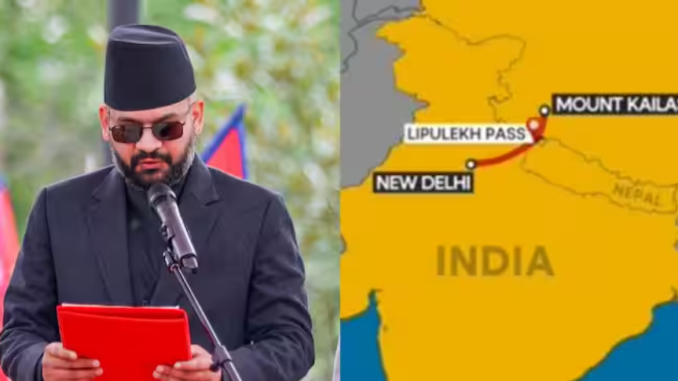
Lipulekh: India and Nepal are at odds again over a Himalayan pilgrimage route. The flashpoint is Lipulekh Pass, a high-altitude crossing in a region both countries have claimed as their own for decades. The dispute is old. The latest trigger is new. Nepal’s Ministry of Foreign Affairs on Sunday issued a formal statement in response to media queries about the Kailash Mansarovar Yatra operating through Lipulekh.
The ministry said Limpiyadhura, Lipulekh, and Kalapani, the entire tract east of the Mahakali River, have been integral parts of Nepali territory since the Sugauli Treaty of 1816. Kathmandu said it has once again conveyed its position and concerns to both India and China through established diplomatic channels.
Nepal’s government said it has previously and consistently raised objections with New Delhi over activities in the disputed area, including road construction, border trade, and any pilgrimage-related operations passing through terrain Kathmandu considers its own.
Nepal has also separately informed China of its position. Beijing was told that Lipulekh falls within Nepali territory, and that Kathmandu’s stand on the matter remains unchanged.
Despite the friction, Nepal said it remains committed to resolving the boundary dispute through dialogue. The government stated it wants a settlement grounded in historical treaties, verified facts, period maps, and documentary evidence, not unilateral action on the ground.
Kailash Mansarovar Yatra 2026
The immediate cause of the statement was an announcement made by India’s Ministry of External Affairs confirming the resumption of the Kailash Mansarovar Yatra. The pilgrimage, organised by the MEA in coordination with the Chinese government, is scheduled to run from June to August 2026. This year, 20 batches of 50 pilgrims each will undertake the journey. Ten batches will travel through Uttarakhand, crossing into Tibet via Lipulekh Pass. The remaining ten will travel through Sikkim, crossing at Nathu La Pass. The official website kmy.gov.in has been opened for applications. Pilgrims will be selected through a computer-generated draw designed to be random and gender-balanced.
Kailash Manasarovar Yatra organised by the Ministry of External Affairs in coordination with the Government of the People’s Republic of China is set to take place during June to August 2026: India Statement
What Is the Lipulekh Dispute?
This is not a fresh controversy. In 2020, Nepal’s KP Oli government dramatically redrew its official map to include Kalapani, Lipulekh, and Limpiyadhura, cementing the claim through a constitutional amendment and intensifying the standoff with India.
Both countries agree on one thing:
The Kali River is the border (from the 1816 treaty).The problem is:
They disagree on where the river starts.Nepal says: the river starts at Limpiyadhura (farther west)
India says: the river starts near Kalapani (farther east)Why this matters:
Where you place the starting point moves the entire border.If Nepal is right → the land (Kalapani, Lipulekh) is in Nepal
If India is right → the same land is in IndiaThe root of the conflict stretches back more than two centuries. The 1816 Treaty of Sugauli, signed between the Kingdom of Nepal and British India following the Anglo-Nepalese War, established the Kali River as the border between the two territories. That single clause has driven the dispute ever since, because the two sides do not agree on where the Kali River actually begins.
Nepal’s position is that the river originates at Limpiyadhura, a source point situated northwest of Lipulekh Pass. Under that reading, the Kali flows from Limpiyadhura southward, meaning the entire Kalapani, Lipulekh, and Limpiyadhura region falls to the west of the river and therefore within Nepali territory. India’s position is different. New Delhi maintains that the river originates at springs located near Kalapani village, a starting point that places the disputed tract inside the Indian state of Uttarakhand. Two countries, one treaty, two rivers, that is the core of a dispute that has resisted resolution for generations.
Leave a Reply