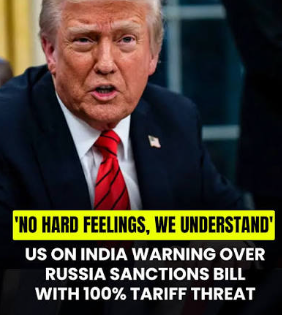
The United States has taken note of India’s warning that a new law targeting buyers of Russian energy could affect bilateral ties, but a senior State Department official sought to play down the tensions, saying there were “no sort of hard feelings” over New Delhi’s response.
The Lindsey O. Graham Sanctioning Russia and Iran Act of 2026 gives US President Donald Trump the authority to impose tariffs of up to 100% on major purchasers of Russian oil and gas. India and China are among the countries that could face the measures. The law also gives the US President broad powers to waive the sanctions on national security grounds.
The comments came after India warned that the legislation could have implications for its relationship with Washington as well as global energy markets.
“Of course, the Indian government has to respond. Congress took a pretty hard approach, especially publicly. You had members of Congress calling out India in particular, so of course India has to respond. We understand that they have a domestic constituency, as do we. Like there’s no sort of hard feelings on any of that kind of activity,” the senior US official said, according to a Hindustan Times report.
India’s Ministry of External Affairs had earlier said the issue had been raised repeatedly with US officials.
“This issue has been discussed at high levels in recent months with various US interlocutors. Its potential implications for not just the bilateral relationship but also the international energy market have been very clearly articulated by the Indian side,” the MEA said, as per the reports.
Trump has ‘another tool’, US official says
The official stressed that the passage of the legislation does not necessarily mean that the tariffs will be imposed immediately.
According to the official, the law gives Trump “another tool in his toolkit”, while also providing a “broad national security waiver”. The official declined to say whether India would receive such a waiver, but said there could be circumstances in which the President chooses to use the authority.
“The President now has another tool. That does not necessarily mean he deploys it. And he has a broad national security waiver, and so we’ll see what that looks like in the coming days,” the official said.
The issue was also discussed when External Affairs Minister S Jaishankar met US Secretary of State Marco Rubio during the UN General Assembly high-level week in New York. Jaishankar said he had reiterated India’s interests and concerns regarding the legislation.
Rubio, according to the US State Department’s readout, also said Washington could be “well positioned” to help countries meet their energy security needs.
US points to alternative energy supplies
Asked whether Washington would help India diversify its energy supplies as it faces possible pressure over Russian oil purchases, the senior official said India had been seeking to diversify for years because of its large energy requirements.
“India has been looking for a long time to diversify its energy sources. They’re a country that has massive energy needs,” the official said.
The official said disruptions involving Venezuelan and Iranian oil had limited India’s options, but argued that changing conditions could give countries such as India greater access to Venezuelan supplies.
“Now, with President Trump’s incredibly successful operation in Venezuela, we are moving into a better position that countries like India are going to be able to get access to that market, and that’s something the Secretary (Rubio) has talked about publicly that he’s working tirelessly on, and the Indians are very interested,” the official said.
The State Department official also pointed to Washington’s broader engagement with New Delhi, including cooperation through the Quad. The official noted that Rubio is scheduled to visit India in October, his second visit to the country this year.
The comments come as both sides seek to manage differences over Russian energy purchases while maintaining cooperation across a wider range of strategic issues.
Bureau Report
Leave a Reply