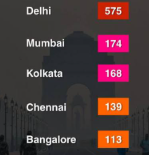
Air pollution levels across India’s four major metropolitan cities showed a sharp contrast on Monday, November 9, with Delhi continuing to face the worst air quality, while Mumbai, Kolkata and Chennai recorded considerably lower pollution levels.
According to the latest available Central Pollution Control Board (CPCB) daily readings for November 8, Delhi recorded an Air Quality Index (AQI) of 376, placing it in the ‘Very Poor’ category.
Kolkata followed with an AQI of 162, while Chennai recorded 138 and Mumbai reported 132. All three cities remained in the ‘Moderate’ category.
The figures underline the widening difference in air quality between the national capital and the other major metros as winter sets in.
Delhi Continues To Grapple With Toxic Air
Delhi’s pollution situation remains particularly concerning. The national capital recorded a daily average AQI of 382 on November 6, prompting the Commission for Air Quality Management (CAQM) to invoke Stage III of the Graded Response Action Plan (GRAP) across Delhi-NCR with immediate effect.
The decision came after forecasts by the India Meteorological Department (IMD) and the Indian Institute of Tropical Meteorology (IITM) indicated that pollution levels could deteriorate further and potentially enter the ‘Severe’ category.
Under GRAP Stage III, restrictions include curbs on construction and demolition activities, alongside tighter pollution-control measures. Authorities have also been asked to strengthen enforcement of existing restrictions.
The CAQM attributed the deterioration to unfavourable meteorological conditions that were preventing pollutants from dispersing.
Mumbai, Kolkata And Chennai Record Lower AQI
In comparison, the other three metros reported significantly better air quality.
Mumbai’s AQI stood at 132, while Kolkata recorded 162. Chennai, with an AQI of 138, also remained in the ‘Moderate’ category.
However, lower readings do not necessarily mean the absence of health risks. Under India’s National AQI classification, readings between 101 and 200 can cause breathing discomfort to people suffering from lung diseases, including asthma. Children, older adults and people with existing heart conditions are also vulnerable.
The latest hourly estimates available on November 9 showed further improvement across these cities. Mumbai recorded an estimated AQI of 27, Kolkata 73 and Chennai 94. Delhi’s corresponding estimate stood at 203.
What Do The AQI Categories Mean?
The National Air Quality Index classifies pollution levels into six categories:
– Good (0-50): Minimal impact on health.
– Satisfactory (51-100): Minor breathing discomfort to sensitive people.
– Moderate (101-200): Breathing discomfort to people with lung diseases, children and older adults.
– Poor (201-300): Breathing discomfort to most people on prolonged exposure.
– Very Poor (301-400): Increased risk of respiratory illness on prolonged exposure.
– Severe (401-500): Serious health impacts, including on otherwise healthy people.
The AQI is calculated using several pollutants, including PM2.5, PM10, nitrogen dioxide, sulphur dioxide and ozone. PM2.5 is particularly concerning because these fine particles can penetrate deep into the lungs and enter the bloodstream.
As winter progresses, changing weather conditions, low wind speeds and poor dispersion can contribute to a further deterioration in air quality, particularly across northern India.
Bureau Report
Leave a Reply