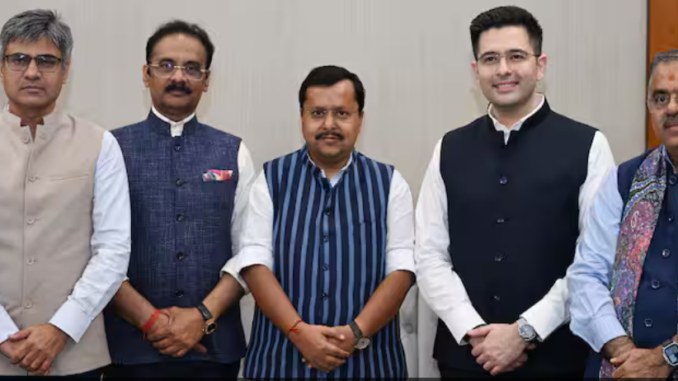
NewDelhi: With the Aam Aadmi Party’s 2/3rd Rajya Sabha Members of Parliament announced aligning with the Bhartiya Janata Party, the crossover has triggered a fresh anti-defection debate, but the group appears to be using the merger exception under the Tenth Schedule to stay clear of disqualification. With seven of AAP’s 10 MPs reportedly moving together, the two-thirds threshold may protect their seats while giving the BJP a stronger hand in the Upper House.
What is the Anti-Defection Law?
According to the tenth Schedule of the Constitution of India, inserted by the 52nd Amendment Act, 1985, to stop elected legislators from switching parties for political gain, the Anti-Defection law allows a legislator to be disqualified if they:
- voluntarily give up membership of their party, or
- vote or abstain from voting against the party whip without permission.
The law applies in both Parliament and state legislative assemblies. Disqualification questions are decided by the Speaker or Chairman of the House.
But here is the twist: how AAP MPs can avoid disqualification. A major exception exists if at least two-thirds of a party’s legislators agree to merge with another party. In that case, the members who move and those who stay are generally protected from disqualification.
Why no Disqualification for Raghav Chaddha and Co.
The seven AAP MPs are trying to present the move as a merger, not an individual defection. In that framing, the legal protection applies because the merger clause is the exception built into the law.
Here is how the Aam Aadmi Party (AAP) had 10 Rajya Sabha MPs, and seven equals exactly two-thirds, which is why the group is being described as crossing the safe legal line.
When the merger condition is met, neither the MPs who join the other party nor those who remain are supposed to face disqualification. That is the basis on which these MPs are arguing that they can keep their seats.
Why Number 7 matters?
AAP’s 7 out of 10 , i.e., the 2/3 MPs saved from individual disqualification. Anything less than 7 can lead to disqualification.
Politically, the BJP gains immediately because it adds strength in the Rajya Sabha and improves its ability to push legislation and manage numbers.
This shift increases the NDA’s tally; currently, the BJP has 106 members, and the NDA stands at 141, including seven nominated members. These numbers are expected to rise to 113 and 148, respectively. The move is not just symbolic; it has direct arithmetic value for the ruling side.
2/3 AAP MPs announce merger with the BJP in the Rajya Sabha
Former AAP deputy leader in the Rajya Sabha, Raghav Chadha, on Friday announced, “We have decided that two-thirds of AAP’s Rajya Sabha members will exercise the provisions of the Constitution of India and merge with the BJP.”
He said that seven MPs had signed a letter to that effect, which was submitted to the Rajya Sabha Chairman. After announcing their decision, the seven lawmakers also met BJP president Nitin Nabin.
Raghav Chadha said AAP has 10 Rajya Sabha MPs, and seven of them, two-thirds of the total, are with the group. Other AAP MPs who have decided to join the BJP include Swati Maliwal, Harbhajan Singh, Sandeep Pathak, Ashok Mittal, Rajinder Gupta, and Vikram Sahni.
Bureau Report
Leave a Reply