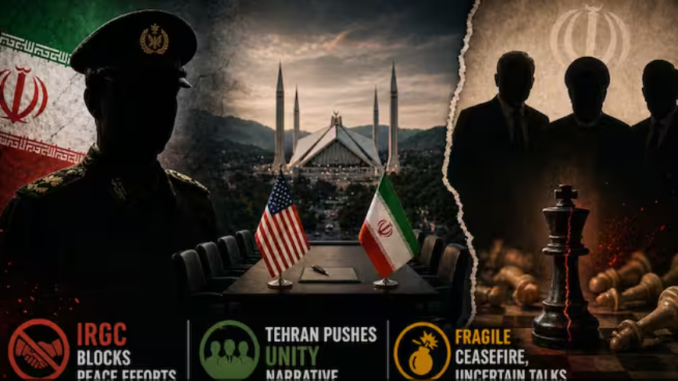
Tehran: While US negotiators and Iranian Foreign Minister Abbas Araghchi have arrived in Islamabad for talks with Pakistani leaders, Tehran has officially clarified that no direct meetings are scheduled between the two adversaries. However, this public stance masks a deep internal crisis. A new assessment by the US-based think tank, the Institute for the Study of War (ISW), reveals that the Islamic Revolutionary Guard Corps (IRGC) is actively meddling in peace efforts.
According to the report, IRGC Commander Brigadier General Ahmad Vahidi and his “inner circle” have repeatedly blocked attempts by Parliament Speaker Mohammad Bagher Ghalibaf and other pragmatist officials to adopt a more flexible negotiating position.
ISW indicates that Vahidi appears to have prevailed in this internal power struggle, steering the regime toward a “maximalist and uncompromising stance.” Sources suggest that Ghalibaf has grown so frustrated with these internal divisions that he has considered resigning from the negotiating team, with some outlets claiming he has already stepped down due to disagreements over nuclear concessions.
Tehran pushes ‘unity’ narrative
These revelations come as Washington points to significant fractures in Iran’s leadership. Tehran, however, is working overtime to project stability. On Friday, the regime released a “Unity Photo” featuring President Pezeshkian, Ghalibaf, and Judiciary Chief Mohseni-Ejei, dismissing claims of a rift.
Ghalibaf himself doubled down on this narrative, dismissing the idea of internal “radicals or moderates” and warning that Iran’s “iron unity” would make its enemies regret their actions.
“In Iran, there are no radicals or moderates; we are all ‘Iranian’ and ‘revolutionary,'” Ghalibaf stated. “With complete obedience to the Supreme Leader, we will make the aggressor criminal regret his actions. One God, one leader, one nation, and one path, the path to victory for Iran.”
Fragile ceasefire and uncertain peace talks
This internal friction comes at a perilous moment. Iran remains a powder keg under a fragile ceasefire following the February 28 assassination of Supreme Leader Ali Khamenei. As Jared Kushner and Steve Witkoff land in Pakistan for potential trilateral mediation, the central question remains: Is the Iranian delegation in Islamabad there to find peace, or are they merely acting as a front for an IRGC leadership that is increasingly willing to risk renewed conflict?
Bureau Report
Leave a Reply