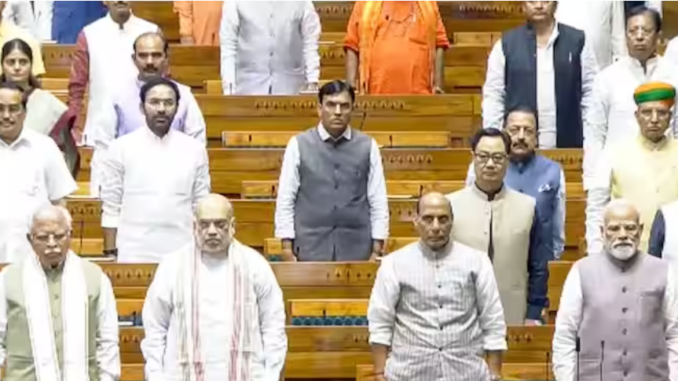
MadhyaPradesh: UCC in India: BJP-ruled Madhya Pradesh has constituted a high-level committee to examine the feasibility of implementing a Uniform Civil Code (UCC). The decision, announced by the Department of Law and Legislative Affairs, aims to harmonise the diverse personal and family laws currently followed by different communities in the state. The UCC committee will be chaired by Justice (Retd.) Ranjana Prasad Desai, a former judge of the Supreme Court. Notably, the UCC remains a key poll agenda of the Bharatiya Janata Party for decades.
BJP’s wider UCC promise
The assembly elections in Assam and West Bengal showed that the UCC is not only a poll card but a serious consideration within the BJP leadership. The BJP has now promised to implement the UCC in Assam and West Bengal if voted to power. The UCC campaign was led by none other than Union Home Minister Amit Shah himself. “UCC is not the agenda of the Bharatiya Janata Party; it is the agenda of the Constitution of India,” said Shah while addressing a rally in Bengal. Pitching for the Uniform Civil Code (UCC) in Assam, Shah said it would ensure equality by prohibiting practices like multiple marriages.
Madhya Pradesh, Chhattisgarh in line
Notably, two BJP-governed states – Uttarakhand and Gujarat have already passed and enacted the Uniform Civil Code. While Uttarakhand was the first state of independent India to implement the UCC, Gujarat recently implemented the rule, becoming the second such state.
The move is now being followed by states like Chhattisgarh and Madhya Pradesh, both ruled by the BJP. The Chhattisgarh Cabinet, led by Chief Minister Vishnu Deo Sai, on April 15 constituted a committee to draft a Uniform Civil Code (UCC) for the state. The panel will be headed by retired Supreme Court judge Ranjana Prakash Desai, with the Chief Minister authorised to nominate its members. The Chhattisgarh government said that the proposed code aims to bring uniformity in laws related to marriage, divorce, inheritance, adoption and maintenance, which are currently governed by different personal laws.
What does the Constitution of India say about UCC?
The initiative aligns with Article 44 of the Indian Constitution and is intended to promote equality and simplify the legal system. “The State shall endeavour to secure for the citizens a uniform civil code throughout the territory of India,” reads Article 44 under the Directive Principles of State Policy of the Indian Constitution.
How BJP plan to overcome legal hurdles?
The BJP leaders have time and again said that they are well aware of the legal challenges in the way of rolling out nationwide UCC. The 23rd Law Commission of India has already been examining the Uniform Civil Code (UCC) as part of its terms of reference.
Union Home Minister Amit Shah had earlier said that the BJP-governed states will implement the Uniform Civil Code and will see how those laws fare when challenged before the courts. The legal judgments will then form a basis for the UCC provisions that are accepted by all.
Therefore, the ideal situation for the BJP is to implement the UCC first in all the states governed by it, one by one, and then reach a state where the majority of the states have the UCC in place, say political observers. This way, a broad consensus will be arrived on contentious provisions of the UCC which will pave way for tha national law, they said.
What does the opposition say?
The opposition has been opposed to the UCC and has termed it unnecessary, socially divisive, and a ‘polarisation’ tactic by the BJP. The Congress party has said that there are a few judgments of the Supreme Court, which have observed that if the UCC is enacted in one go, it could prove counter-productive to the unity of the nation.
“Some other judgments also say that only those personal laws which are not related to religion can be codified. Even the 21st Law Commission, headed by a former Supreme Court judge, Balbir Singh Chauhan, came to a conclusion that the enactment of the UCC is neither desirable nor necessary at this stage. In a report submitted in August 2018 in a 185-page consultation paper on ‘Reforms of Family Law’, the Commission said, ‘Cultural diversity cannot be compromised to the extent that our urge for uniformity itself becomes a reason for threat to the territorial integrity of the nation’,” said Congress on its website.
Trinamool Congress has also launched a sharp attack on the BJP’s promise to implement the Uniform Civil Code (UCC) in West Bengal. TMC General Secretary Abhishek Banerjee claimed it is a move that would undermine the state’s diversity. “UCC means that it will be imposed on you, which religion you will be allowed to follow. The BJP will decide what you will do….BJP says UCC means they will decide how I will practise my religion,” said Banerjee.
Bureau Report
Leave a Reply