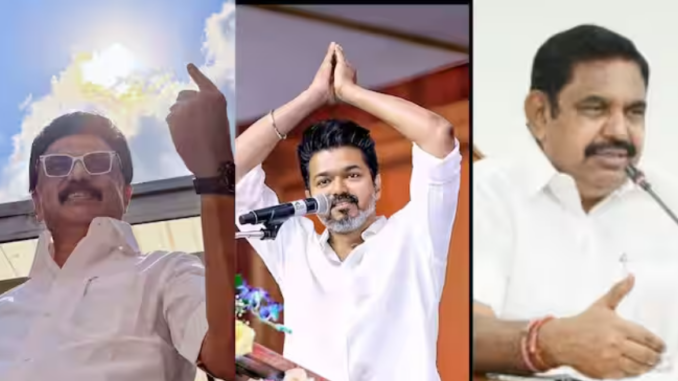
TamilNadu: In the 2026 Tamil Nadu Assembly elections, held on April 23 with counting on May 4, actor Vijay’s Tamilaga Vettri Kazhagam (TVK), a party launched just in 2024, emerged as the single largest party in its debut, winning 108 seats with around a 32–35% vote share. The ruling DMK was sharply reduced to 73 seats, while the AIADMK also weakened, securing 52 seats. TVK fell just short of the 118-seat majority mark in the 234-member Assembly.
TVK’s win marks a significant disruption to Tamil Nadu’s long-standing Dravidian duopoly (DMK and AIADMK dominance for over 50-60 years), it may not be a complete “end” yet, more like a powerful crack in the system.
Dravidian duopoly
Since the 1960-70s, DMK and its offshoot AIADMK (founded by MGR) have alternated power, rooted in Dravidian ideology (social justice, Tamil pride, anti-Brahmin/anti-Hindi roots from Periyar). Cinema stars like MGR and Jayalalithaa earlier leveraged popularity into politics successfully.
TVK’s surge: Vijay, popular as Thalapathy among his fans, contested all 234 seats solo without any major alliances, drawing high, drawing high turnout (around 85%). It cut into both DMK and AIADMK bases, primarily appealing to youth, women, and those frustrated with dynastic politics, perceived corruption, and incumbency against DMK’s MK Stalin along with promises like women’s financial support and a “drug-free” Tamil Nadu resonated.
CM MK Stalin lost the Kolathur Assembly constituency to TVK’s VS Babu with 8795 votes. TVK performed strongly even in traditional strongholds.
TVK’s win is seen as historic as it is first major non-traditional Dravidian force to lead Tamil Nadu in decades, echoing MGR’s 1977 breakthrough but as a fresh entrant.
What it means for Tamil Nadu
Political realignment: With TVK emerging as the single largest party by winning 108 seats but falling short of the 118-seat majority mark, the result has led to a hung Assembly. For the formation of government TVK will need support, possibly from AIADMK (to keep DMK out) or independent and smaller parties. It will be interesting to see who will be the kingmaker in the TVK led Tamil Nadu.
Weakened DMK/AIADMK: Both parties face soul-searching. DMK as opposition; AIADMK may seek relevance through alliances. The binary is broken, forcing more competitive, multi-polar politics.
Vijay as new pole: Massive fan base (“Anil” army) translated into votes. His clean image and star power provide momentum, but governing tests organizational depth and experience.
2. Policy and governance shifts
Continuity with change: TVK draws from Dravidian roots (social justice, Tamil identity) but positions as a “new” alternative, less dynastic, more welfare-focused and anti-corruption. Expect emphasis on youth employment, women’s schemes, education, and social reforms.
3. Broader implications
Youth and anti-incumbency wave: High turnout signals demand for change beyond caste/Dravidian binaries. Cinema-politics link remains strong but now includes newer idols. However, Vijay’s win also revives Jayalalithaa-style star power politics.
Not the full end of Dravidian politics: Ideology of social justice, federalism, Tamil pride likely persists; TVK is often described as repackaging or inheriting elements of it rather than rejecting wholesale.
Risks and challenges for TVK
TVK is untested in power, scaling from fan mobilization to administration, coalition management, and bureaucracy will be tough. Stability depends on alliances. Long-term, it could evolve into a new dominant force or face fragmentation.
Overall, this is a tectonic shift as Tamil Nadu voters decisively rejected the old duopoly in a three-cornered fight. It injects fresh energy and competition but brings uncertainty around stable governance. Vijay’s success validates star power along with anti-establishment sentiment, potentially inspiring similar experiments elsewhere.
Leave a Reply