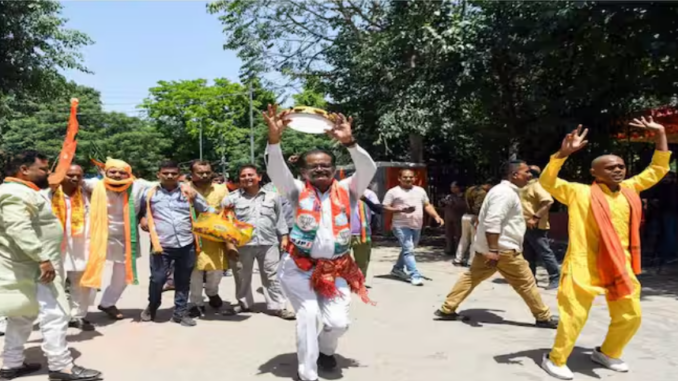
NewDelhi: The BJP’s rise across eastern India is becoming impossible to ignore. From Bihar to West Bengal and Odisha, the party is on course to control states that once seemed out of reach. After years of careful planning, on-the-ground organisation and relentless campaigning, the numbers suggest that the party is finally translating decades of effort into power across the region.
In West Bengal, Mamata Banerjee’s Trinamool Congress (TMC), which ruled for three consecutive terms, has been decimated. Odisha’s long-standing leader Naveen Patnaik has been pushed back, while Bihar’s complex caste-based politics have also tilted in BJP’s favour.
These results have given the party a foothold across the eastern belt, creating what some are calling a new political corridor.
The ancient kingdoms come alive
The eastern sweep of the BJP is described through the lens of India’s historical kingdoms. Bihar, which was known in ancient times as Anga, has long been the centre of coalition politics influenced by caste equations. In the Mahabharata, it was the land gifted by Duryodhana to Karna, and historically, it helped form the core of the Mauryan Empire.
Bengal (or Banga) has long been the hub of the region’s intellectual and cultural energy. The state played a major role in the Bengali Renaissance and anti-colonial movements and made it a politically and ideologically challenging region.
Odisha (Kalinga) carries the legacy of Ashoka’s war and its transformative consequences. Modern Odisha was governed by Naveen Patnaik and his Biju Janata Dal (BJD) for nearly 25 years, consistently resisting both the BJP and the Congress.
Anga turns in BJP’s favour
The BJP-led National Democratic Alliance (NDA) achieved a sweeping victory in Bihar Assembly elections, winning 202 of 243 seats. The Rashtriya Janata Dal (RJD), led by Tejashwi Yadav, fell from 75 seats to only 25 and the Congress was reduced to six seats, while Left parties barely registered on the map.
The BJP secured 89 seats, the Janata Dal (United) 85, Chirag Paswan’s Lok Janshakti Party (Ram Vilas) 19, Jitan Ram Manjhi’s Hindustani Awam Morcha five and Upendra Kushwaha’s Rashtriya Lok Morcha four.
Previously expected to disrupt the state’s politics, Prashant Kishor’s Jan Suraaj Party failed to make a mark.
Breaking the Banga barrier
Bengal had long been the toughest challenge for the BJP. The managed to make its presence felt over the last decade, but the Trinamool Congress (TMC) maintained its stronghold.
Now, the BJP leading in over 200 seats while the TMC leads in just over 80. Achieving a political milestone in eastern India, the BJP is set to form a government in the state it has never ruled.
Kalinga falls
In Odisha, the BJP ended Patnaik’s 24-year rule, winning 78 of 147 assembly seats. The BJD dropped to 51, the Congress improved to 14, the CPI(M) won one and independents claimed three.
The Lok Sabha results were even more decisive – the BJD failed to win a single parliamentary seat, while the BJP surged to 20 seats and the Congress took one.
The BJP’s rise in Odisha confirms its strength beyond the Hindi heartland.
Completing the Eastern Corridor
With victories in Anga, Banga and Kalinga, the BJP has established a continuous political corridor across eastern India. These results show years of planning, strategy and organisational work by party leaders at both the national and state levels.
For the first time, the BJP is no longer seen as a party limited to northern India. It is a dominant force influencing politics across the eastern states.
Leave a Reply