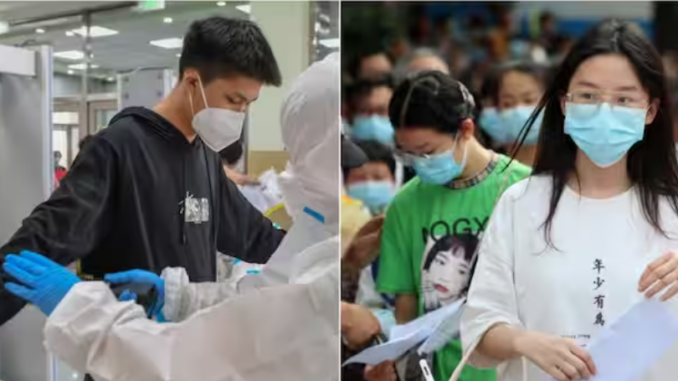
China: NEET 2026 vs. Gaokao: After India faced an unfortunate NEET UG 2026 exam paper leak, affecting almost 2.2 million students, who had no choice but to cancel their examinations, all eyes have turned towards China’s high-risk testing process. While the NTA is coming under tremendous scrutiny regarding their management failure, China’s National College Entrance Exam, or the Gaokao, serves as an example of leak-free test security with some extraordinary high-security measures.
Secretive procedure: Military camps and absolute seclusion
Since this test is considered a prestige issue for China, the whole process takes place with utmost secrecy, even before a single candidate steps into an examination hall.
Experts selected: Three months prior to the exam, senior teachers are handpicked from different universities and schools to create question papers for the examination.
Isolated locations: The selected experts are sent off to remote areas like military camps and high-security prisons.
No connections allowed: This time, teachers are cut off from internet access and communication. They only use landline phones to communicate with someone on the other end and can only get out of these places once the examination takes place.
Behind bars: Maximum security print shop
The security of millions of prints is the following stage that requires careful consideration. The number of students who took the Gaokao exceeded 13 million in 2024 alone.
Joint control: According to information published by the South China Morning Post, the test papers are printed in maximum-security facilities controlled jointly by the Ministry of Education and the National Administration of State Secrets Protection.
24/7 supervision: Special guards and cameras are installed in printing shops. Printers work and live separately, thus minimising any leakage risk.
Transportation security: Guarded heavier than cash
Moving Gaokao papers throughout the country requires greater security measures than handling bank cash or valuable currencies.
Armored transportation: Special trucks commissioned for paper transportation are fitted with satellite navigation and monitoring systems.
Guards: The drivers and escorts of these convoys consist of members of law enforcement agencies, the army, and examination authorities.
Stealth room: After reaching the examination center, the Gaokao papers are stored in specially designed rooms with reinforced steel walls. A designated crew must accompany the papers inside these rooms for food and sleep until the test starts. These rooms are connected to police alarm systems and monitored via motion sensors.
Tech lockdown: Turning off AI and social media functionality
As a new strategy, the Chinese government uses tech giants to ensure that exams are legitimate.
Function suspension: According to reports, ByteDance (TikTok) and Alibaba shut down specific AI and “question and answer” services while exams take place.
AI constraints: Several technologies, including the AI-powered DeepSeek and Kimi, have turned off the image recognition and solving functionalities to prevent cheating via technology.
Digital jammers: Exam centers make use of digital jamming, biometric identification, and enhanced examination of digital devices.
AI inspection post-exams: Using AI to examine test-takers
However, the scrutiny continues even after the clock stops ticking for China as it utilises advanced AI technologies.
Behaviour analysis: The use of AI to monitor student behavior and flag anything unusual like whispers or eye movements.
Severe sanctions: In provinces like Jiangxi, the footage from exam halls is analyzed using the same approach, and any violation is sanctioned severely according to law.
Leave a Reply