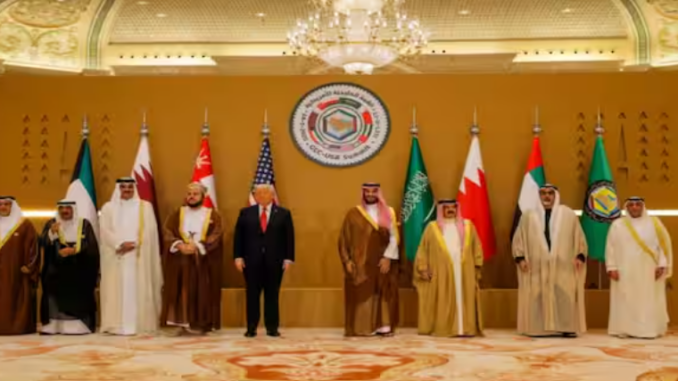
UnitedStates: The ongoing conflict in West Asia has added new weight to ongoing debates in the Gulf about how much the region can still rely on the United States for security support. For decades, countries in the Gulf Cooperation Council (GCC) have leaned on Washington as the security provider, but the US-Israel’s war against Iran has tested that arrangement in new ways.
During the military confrontation, several GCC states witnessed their strategic facilities come under threats from missiles and drones launched by Iran. Regional authorities tracked the attacks while also trying to understand what level of support they could expect from the United States at the same time. Many in governments felt the region had been drawn into a situation where they were not properly consulted beforehand.
This has brought back an old but important question in Gulf policy debates about how reliable US security guarantees are when tensions rise in the region. It has also led to debate on whether Gulf countries are trying to depend less on Washington or whether present risks are making them depend on it even more.
A long history of security ties
The US presence in the Gulf did not develop overnight. After the Second World War, Washington gradually replaced Britain as the main external power in the region. Two major factors drove this involvement – the strategic importance of the Gulf’s geography and its vast oil reserves, along with the goal of limiting Soviet influence during the Cold War.
Then US President Franklin Roosevelt had set out this direction in 1943 when he said, “America’s defence is very important for the defence of Saudi Arabia.”
In 1945, his meeting with then King Abdulaziz Al Saud on the USS Quincy is viewed as the beginning of a long-term strategic relationship between the two countries.
Over the years, the United States built a network of military bases and logistics support across the region. By 1949, Dhahran had become one of its busiest overseas air bases after Germany. This shows how important the Gulf had become to US operations.
From Cold War strategy to Gulf War reality
During the Cold War, the United States viewed Saudi Arabia and Iran as major pillars of regional stability and supplied both with weapons and military training. This continued into the 1970s, when Washington strengthened defence ties with Gulf nations through agreements, training and access to facilities.
The 1973 oil crisis weakened relations after oil exports were restricted to countries supporting Israel, including the United States. A major turning point came in 1979 with the Iranian revolution, which brought down the Shah, a close US ally. In the same year, the Soviet invasion of Afghanistan further increased US concern about regional security.
By 1980, then US President Jimmy Carter made Washington’s position clear by declaring that “any attempt by any outside force to gain control of the Persian Gulf region will be repelled by any means necessary, including military force”.
The formation of the GCC in 1981 created a regional structure for cooperation, but in practice, the United States continued to be the main security provider. This role became even more visible during the Gulf War of 1990-91, when US-led operations such as ‘Desert Shield’ and ‘Desert Storm’ were launched to defend Saudi Arabia and “liberate” Kuwait.
Changing expectations in recent years
Over time, Gulf states have also increased their partnerships beyond the United States, building ties with countries such as China, Russia and European nations. Some recent incidents, including limited US responses to attacks on energy facilities and airports in the region, have added to concerns about the reliability of American protection.
At the same time, Gulf economies were directly affected by recent missile and drone attacks on infrastructure such as oil facilities, ports and desalination plants. These incidents exposed weak points in defence systems and raised concerns about long-term preparedness.
Despite this, analysts say the United States is the main pillar of regional defence. Analysts say the US-Iran conflict may lead to greater reliance on Washington rather than a complete distancing from it. While trust may be tested, they say, operational dependence is likely to continue due to the lack of comparable alternatives.
They also point out that while countries such as China and Russia are expanding their presence, they are not so far positioned to replace the United States in areas such as air defence coordination, intelligence sharing and rapid military response.
According to experts, it is possible that the United Arab Emirates (UAE) strengthens its security ties with Israel, and Saudi Arabia may also extend its regional relations with Turkey and Pakistan more than before.
The US-Iran-Iran war exposed disconnect between expectations and reality, as well as the weaknesses in the America-Gulf security alliance. The main challenge for Gulf countries now is how they manage their dependence on the American security umbrella.
As the kingdoms continue to reassess their options, the balance between diversification and dependence is becoming more complex, while the United States still is at the centre of the region’s security structure.
Leave a Reply