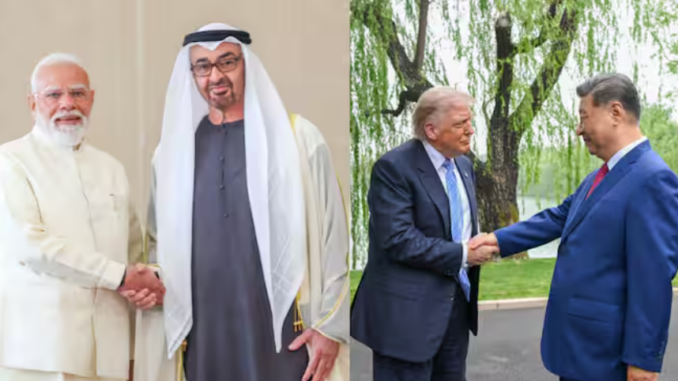
UnitedArab: At a time when rising tensions in West Asia and disruptions around key maritime routes are fuelling fears of an energy crisis, India has moved quickly to strengthen its long-term oil and gas security. Prime Minister Narendra Modi arrived in the UAE on the first leg of his five-nation tour, where India and the United Arab Emirates signed seven major agreements in just four hours. The deals span strategic oil reserves, LPG and LNG supply, defence cooperation, infrastructure investment and artificial intelligence.
In today’s episode of DNA, Rahul Sinha, Managing Editor of, analysed how India’s short but outcome-driven engagement with the UAE stood in sharp contrast to US President Donald Trump’s much longer Beijing visit, which ended without any major formal agreement between the United States and China.
PM Modi’s UAE visit
One of the most important agreements signed during Modi’s UAE visit focused on strategic petroleum reserves. The agreement was signed between Indian Strategic Petroleum Reserves Limited (ISPRL) and Abu Dhabi National Oil Company (ADNOC). ISPRL is responsible for maintaining India’s emergency crude oil reserves, which are used to protect the country during wars, supply disruptions or major global crises.
India currently operates strategic oil storage facilities in Visakhapatnam, Mangaluru and Padur, with a combined capacity of over 5 million metric tonnes of crude oil. These reserves can meet the country’s oil demand for nearly 9 to 10 days if global supplies are disrupted.
Under the new arrangement, ADNOC will now be able to store nearly 30 million barrels of oil in India. India is also planning to expand its storage network by building additional reserves at Chandikhol in Odisha and Padur. Once completed, India’s emergency oil reserve capacity is expected to rise to nearly 12 million metric tonnes, enough to support the country for more than 20 days during a crisis.
Officials are also exploring the possibility of building emergency oil storage facilities for India in Fujairah in the UAE. The move comes at a time when concerns over the Strait of Hormuz and instability in West Asia continue to affect global energy markets.
India and the UAE also signed a long-term LPG supply agreement between Indian Oil Corporation and ADNOC. LPG remains essential for millions of Indian households, especially under the Ujjwala scheme, and is widely used in hotels and small industries. The long-term agreement is expected to ensure a more stable supply and reduce price fluctuations during periods of global uncertainty.
The two countries also agreed to deepen cooperation in LNG and LPG storage infrastructure. LNG plays a major role in electricity generation, fertiliser production, factories, and CNG transportation in India, making an uninterrupted supply strategically important.
Beyond energy, India and the UAE signed agreements on defence and security cooperation, covering cyber defence, maritime security, advanced technologies, joint exercises, and information sharing. Another key agreement involves the development of a ship repair industrial hub in Vadinar, Gujarat, which is being seen as a major step toward turning India into a global ship repair centre.
The partnership also expanded into emerging technologies, with both countries announcing plans to jointly build a powerful AI supercomputer system in India. In addition, the UAE committed to investing $5 billion in India’s infrastructure sector.
During the visit, Prime Minister Modi also strongly condemned attacks on the UAE, underlining concerns over the safety of the nearly 3.5 to 3.8 million Indians living there. The Indian community forms a major part of the UAE’s population, and any instability in the Gulf region has a direct impact on Indian citizens as well as India’s energy security.
Trump-Xi Jinping meet
On the other hand, US President Donald Trump met with Chinese President Xi Jinping during his recent visit to Beijing. Trump spent more than 40 hours in China and travelled with several top American business leaders, hoping to secure major economic deals and strengthen trade ties.
While the visit featured elaborate ceremonies, including a 21-gun salute, high-profile meetings, and state dinners hosted by Chinese President Xi Jinping, no major formal agreement emerged from the trip. Trump claimed that China had shown interest in purchasing Boeing aircraft, American soybeans, beef and oil, but Beijing did not officially confirm these announcements.
The two sides also discussed trade coordination mechanisms, rare earth minerals and the importance of keeping the Strait of Hormuz open for global oil supplies. However, much of the visit remained focused on diplomatic messaging and future possibilities rather than concrete outcomes.
The Taiwan issue also drew attention during the visit. Observers noted that Trump avoided making strong public comments on Taiwan after meeting Xi Jinping, despite the US traditionally maintaining a firm position on the matter. Critics in the US viewed this silence as a sign of growing pressure from Beijing.
The broader contrast between the two visits was hard to miss, while India and the UAE used a brief diplomatic engagement to finalise several long-term strategic agreements, the much longer US-China meeting ended with few tangible results despite its global attention and high-profile optics.
Leave a Reply