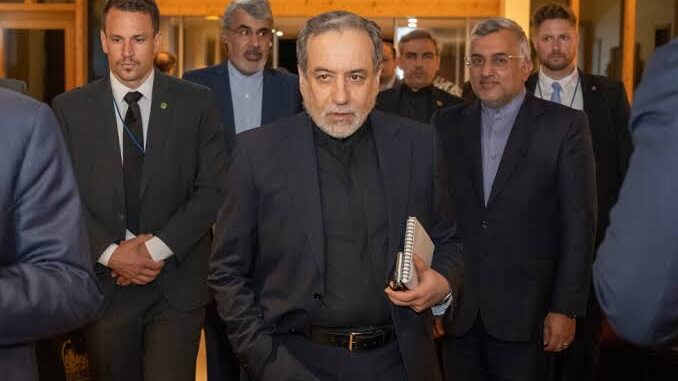
Iran has shared the details of ‘encouraging’ first rounds of negotiations with the United States as the two sides prepare to meet again in Switzerland. Sharing details of the first rounds of negotiations, Iran said that a high-level committee will be established to provide political oversight of the mediation process. It also shared that transit through the Strait of Hormuz and peace in Lebanon were part of the discussion.
“Qatar and Pakistan, mediators of the Iran–US talks, announced the conclusion of the first high-level round under the Islamabad Memorandum in Bürgenstock, Switzerland. The opening day was described as positive and constructive, with encouraging progress achieved,” said Iran Government on X.
Sharing details, it further said, “The parties agreed to establish a High Committee to provide political oversight of the mediation process. Senior negotiators will report regularly and guide working groups on nuclear issues, sanctions, monitoring, and dispute resolution.”
Iran shared that the High Committee approved a roadmap aimed at reaching a final agreement within 60 days, paving the way for immediate technical talks.
“A direct communication channel has also been established to prevent incidents and ensure safe navigation through the Strait of Hormuz. The parties further agreed to create a Conflict Control Unit involving Lebanon, with facilitation by the mediators, to support adherence to the cessation of military operations. Technical discussions will continue in Bürgenstock through the end of the week,” it said.
Earlier, Qatar said in a statement that the first session of high level talks under the framework of the Islamabad Memorandum of Understanding have concluded in Burgenstock in a positive and constructive atmosphere. “Encouraging progress has been made including the creation of a mechanism for further technical talks. Building on the MoU, the parties have agreed to the establishment of a High Level Committee, which will provide political oversight on the mediation. Chief negotiators will report regularly to the High Level Committee and lead working groups focused on nuclear, sanctions, and a monitoring and dispute resolution group to ensure the effective implementation of the MoU, and on other matters,” said the Qatar’s Ministry of Foreign Affairs.
It further said that a communication line between the parties has been formed for the period mentioned in paragraph 5 of the MoU to avoid incidents and miscommunication with the aim of safe passage for commercial vessels through the Strait of Hormuz.
“Moreover, the parties agreed on the creation of a de-confliction cell, between the parties, the Lebanese Republic and facilitated by the Mediators, to ensure the adherence of the termination of military operations in Lebanon as per the MoU. Technical talks will continue for the remainder of the week at the Burgenstock resort on all issues. The mediating parties will continue to do their utmost to ensure that the negotiations continue to be conducted in a constructive atmosphere with the aim of reaching a final deal,” said Qatar.
Meanwhile, the Trump administration is presenting its new diplomacy with Iran as more than an effort to end a four-month conflict, arguing that the talks could open the door to a broader transformation of the Middle East.
As Vice President JD Vance met Iranian officials in Switzerland on Sunday, senior administration figures described the negotiations as an opportunity to reduce regional tensions, prevent Iran from acquiring a nuclear weapon and potentially expand the framework of cooperation established by the Abraham Accords.
“What the president has asked us to do is turn over a new leaf to transform our relationship with the people of Iran,” Vance said. He added that if Iran’s leadership abandoned regional instability and nuclear ambitions, the United States would be willing to “fundamentally transform our relationship with that country.”
The administration’s broader objective was outlined by US Ambassador to the United Nations Mike Waltz, who said the negotiations could create conditions for a fundamentally different regional order.
Bureau Report
Leave a Reply