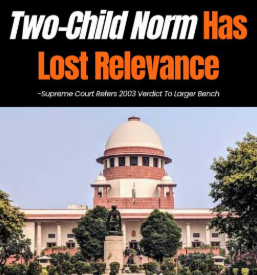
NewDelhi: The Supreme Court on Wednesday questioned the continued relevance of laws barring people with more than two children from contesting local body elections, noting that India’s declining fertility rate and changing demographics have weakened the rationale behind such restrictions, reported Live Law.
A bench comprising Justice PS Narasimha and Justice Alok Aradhe referred the 2003 judgment in Javed v State of Haryana to a larger bench. The top court said laws disqualifying individuals with more than two children from contesting elections warrant reconsideration, particularly in view of India’s declining fertility rate.
The Bench also quashed the disqualification of Mangala Bhimrao, a former Sarpanch of Kakoda Gram Panchayat, under Section 14(1)(j-1) of the Maharashtra Village Panchayat Act, 1959, following the birth of her third child. The provision, which bars individuals with more than two children from holding such positions, came into effect on September 13, 2000, through an amendment to the Act.
The apex court noted that India’s total fertility rate (TFR) had fallen from 3 in 2003 to 1.9 at present.
“We are of the strong opinion that the laws which penalise having more than two children have lost their relevance. The foundation of such laws, that is the fear of over population, has crumbled due to demographic changes in the past few decades. We have explained how, from 2003 after Javed v State of Haryana upheld such laws, India’s total fertility rate has fallen from 3 to 1.9,” Justice Narasimha said, as quoted by Live Law.
The top court further noted that with India’s fertility rate dropping below the replacement level of 2.1, the country could soon undergo demographic changes marked by an ageing population and a shrinking share of the working-age population.
“A total fertility rate of 2.1, known as the replacement rate, would allow one generation to completely replace itself. So even though India’s population is not yet declining, the total fertility rate falling below the replacement rate would soon result in a demographic transition to an older population, with a declining share of the working population,” he further stated.
“Therefore, laws limiting population growth have lost their relevance. If we fail to take note of such demographic changes, India will face serious consequences… This has compelled us to stay the proceedings; we have referred the matter to a larger bench,” he added.
The Court also observed that continuing with the law would exclude an entire class of citizens from political representation.
Notably, in the 2003 judgment in Javed v State of Haryana, a three-judge bench had upheld the constitutional validity of the Haryana Panchayati Raj Act, 1994, which barred people with more than two living children from contesting local body elections.
Bureau Report
Leave a Reply