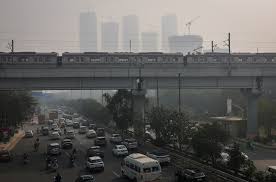
For years, the world has pointed to Delhi as the poster child for India’s air pollution crisis. Images of the capital shrouded in toxic smog, schools shutting down, and flights delayed have become annual winter rituals.
But latest data suggests, it is not Delhi, but the title of world’s most polluted city now belongs to Loni, a rapidly growing urban pocket in Uttar Pradesh.
In 2025, Delhi was ranked as the world’s fourth most polluted city and the most polluted capital, with an annual average fine particulate matter (PM2.5) level of 99.6 µg/m³—nearly 20 times higher than the World Health Organization’s safe limit, as per the report released on Tuesday. The report also found that three of the five most polluted cities globally are in India and 29 of the top 50.
According to the IQAir 2025 World Air Quality Report, Loni recorded an annual average PM2.5 concentration of 112.5 µg/m³, which is more than 22 times the World Health Organization’s (WHO) safe annual guideline of 5 µg/m³. Report said that it accounts for a nearly 23% increase from 2024, making Loni the undisputed no.1 most polluted city globally.
While three other Indian cities, including Byrnihat (Meghalaya), Mullanpur (near Mohali), and others are among the top most polluted cities.
Other cities in the National Capital Region (NCR) also recorded poor air quality. Ghaziabad, with a PM2.5 level of 89.2 µg/m³, ranked seventh globally, while Noida (80.5 µg/m³) ranked 18th, Greater Noida (77.2 µg/m³) 21st, and Gurugram (74.6 µg/m³) 23rd.
What really caused the pollution in Loni?
Located in the Indo-Gangetic Plain, it suffers from the same geographic trap that blankets much of northern India: cold winter inversions that prevent pollutants from dispersing, combined with a toxic cocktail of sources.
Additionally, rapid urbanisation has brought unchecked construction dust and diesel emissions. Industrial growth, coal-based power plants, and vehicular traffic add layers of fine particulate matter.
Seasonal stubble burning from neighbouring agricultural states sends plumes of smoke straight into the region. Weak enforcement of environmental norms has only worsened the crisis.
Report also suggested that the problem is not seasonal anymore, it’s chronic. While Delhi’s pollution often grabs headlines during November–February, Loni’s annual average now surpasses even the national capital’s.
High time for effective measure
India ranked as the sixth most polluted country globally in 2025, with a population-weighted annual average PM2.5 average of 48.9 µg/m³, down slightly from 2024 but still far above safe limits. Only 14% of cities worldwide meet WHO guidelines, and India has none.
Only 13 countries met the WHO standards, French Polynesia, Puerto Rico, U.S. Virgin Islands, Barbados, New Caledonia, Iceland, Bermuda, Réunion, Andorra, Australia, Grenada, Panama and Estonia.
The National Clean Air Programme (NCAP) and the Commission for Air Quality Management (CAQM) have set targets to fight with rising pollution, but enforcement remains patchy. Experts call for stronger action on secondary pollutants (SO2, NO2, VOCs), nationwide reduction goals, and better focus on non-NCR hotspots.
Delhi’s pollution is real and severe, however fixating solely on the capital has overshadowed the wider crisis. Places like Loni and Ghaziabad prove the problem is regional, systemic, and growing.
Cleaner fuels, stricter industrial norms, effective stubble management, and massive investment in public transport and renewable energy aren’t optional, they’re survival imperatives.
Bureau Report
Leave a Reply