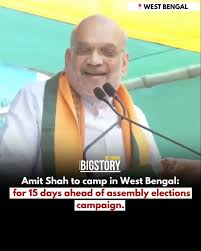
With the West Bengal Assembly election 2026 entering its decisive phase, the Bharatiya Janata Party (BJP) has deployed one of its most senior leaders, Union Home Minister Amit Shah, for an extended on-ground campaign. Shah’s phased 15-16 day stay in the state signals the party’s push to challenge the dominance of Chief Minister Mamata Banerjee and the ruling Trinamool Congress (TMC).
His stay also raises a central question: Can this intensive strategy alter Bengal’s political equation this time?
Bhabanipur turns into the political epicentre
The spotlight is firmly on Bhabanipur, where Mamata Banerjee is locked in a high-profile contest against the Leader of Opposition and her rival Suvendu Adhikari. The constituency has emerged as a prestige battle for both camps, carrying symbolic weight far beyond a single seat.
Addressing a gathering during a roadshow in Bhabanipur, Shah had said that he would be in West Bengal in phases for 16 days until the elections conclude on April 29. Shah also invoked the 2021 contest memory of Nandigram, where Adhikari defeated Banerjee.
Looking back at the 2021 numbers
In the 2021 Assembly elections, the TMC secured 213 seats, marginally improving on its 2016 tally of 211. The BJP, however, made a dramatic leap from just 3 seats in 2016 to 77 seats in 2021. The Congress, meanwhile, failed to open its account in 2021 after winning 44 seats in 2016.
BJP recorded nearly 38 per cent vote share in the 2021 election, a notable rise from around 10 per cent in the 2016 State Assembly elections.
Inside Shah’s 15-day camping strategy
Shah’s extended stay points to a detail-oriented campaign approach. The focus is likely to be twofold: consolidating strongholds where the BJP already has a firm base, and aggressively targeting constituencies it narrowly lost in 2021, while ensuring existing gains are not diluted.
His presence is likely to involve direct engagement with party workers, senior leaders, and booth-level teams, refining last-mile strategies and energising the cadre. Such high-level oversight has been a recurring feature of BJP campaigns in previous elections as well.
At the same time, the strategy appears to balance expansion and consolidation, targeting swing seats without neglecting existing strongholds.
Campaign pitch and key issues
A key theme in Shah’s campaign has been the issue of infiltration. During multiple public addresses, he has linked it to governance, security, and demographic concerns in the state.
Shah has also assured that if the BJP comes to power in West Bengal, land required for border fencing will be arranged within 45 days after the new government takes charge of the administration.
Candidate choices and manifesto push
Reports state the BJP has not fielded any Muslim candidate in the upcoming elections. The party has also continued to roll out its candidate lists, with Rakesh Singh named from Kolkata Port in its latest announcement.
Meanwhile, the BJP is preparing to release its manifesto, likely on April 10 in Kolkata, with a focus on women, farmers, and youth.
Polling schedule
Elections for the 294-member Assembly will be held in two phases, April 23 and April 29, with counting scheduled for May 4.
As voting approaches, the BJP’s high-voltage campaign, anchored by Amit Shah’s prolonged presence, underscores the party’s determination to expand its footprint in Bengal. Whether Shah’s ground strategy can convert momentum into seats, or whether Mamata Banerjee retains her grip, is a question that only the ballot boxes will answer.
Bureau Report
Leave a Reply