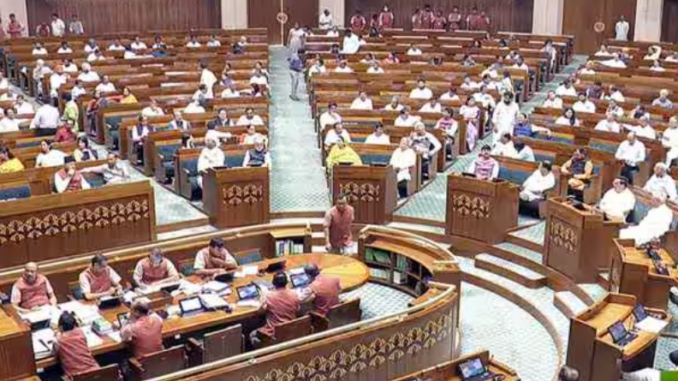
NewDelhi: India is approaching one of the most consequential constitutional moments in its electoral history. The long freeze on seat redistribution in the Lok Sabha is set to end after the 2926 Census concludes. With this, the political balance between North and South could shift dramatically. Despite the rhetoric and partisan framing around it, delimitation is not merely a policy choice—it is, in large part, a constitutional compulsion.
The Constitution (131st Amendment) Bill, 2026, which aimed to provide 33 per cent reservation for women in Parliament, failed to secure the required two-thirds majority, triggering a sharp political confrontation between the ruling NDA and the Opposition INDIA bloc. The proposed legislation, which also sought to expand the strength of the House, could not secure the constitutionally mandated two-thirds majority despite a day-long debate. The Bill received 278 votes in favour and 211 against, falling short of the required threshold for passage.
Constitutional Trigger No One Can Ignore
The delimitation provision emanates from Article 81 of the Constitution of India. This mandates that people’s representation in Parliament should reflect the population as closely as practicable. In simple terms, more people should mean more representatives.
Complementing this are Article 82 of the Constitution of India and provisions related to reservation like Article 330A, which together create a framework where, after every Census, seat allocation and constituency boundaries are meant to be revisited.
However, politics intervened. Through constitutional amendments, India froze the redistribution of seats based on the 1971 Census to encourage population control. That freeze, extended multiple times, is set to lapse after the post-2026 Census exercise.
The implication is stark: if Parliament does nothing, the constitutional logic of population-based representation reasserts itself. Now, since Parliament’s attempt to increase the number of seats through a constitutional amendment has been defeated, the population-based delimitation will trigger the next.
NDA’s Warning Against Bill Failure
As leaders like MP Tejashwi Surya have pointed out, inaction itself is a decision. If no legislative intervention occurs, the current 543 Lok Sabha seats will go under delimitation among states purely on a population basis. This means that states with higher population growth (largely in North India) gain seats and states with lower population growth (largely in South India) lose relative representation.
For example, Tamil Nadu could see its seats fall significantly (some projections suggest a drop toward the low 30s if strict proportionality is applied) from its current 39. Kerala could drop from 20 seats to around 14 under similar projections. This is what the Constitutional amendment sought to address but failed.
Rejecting the opposition’s allegation, Union Home Minister Amit Shah emphasised that no changes have yet been made to the Delimitation law, suggesting continuity rather than disruption. This feeds into a broader argument: that the government, including Narendra Modi, may ultimately have limited room to manoeuvre. The Constitution, as it stands, pushes toward population-based redistribution unless Parliament actively amends the framework again.
So the real question is not whether delimitation will happen—it almost certainly will—but how it will be designed.
The Southern Dilemma
Tamil Nadu Chief Minister MK Stalin protested by burning a copy of the delimitation bill. But the ashes could cost Tamil Nadu a chance to stay politically relevant.
States like Tamil Nadu, Kerala, Karnataka, Andhra Pradesh, and Telangana have achieved lower population growth, while Northern states like Bihar and Uttar Pradesh have higher population. This creates a paradox as it states that controlled population growth may see their political voice shrink while those who failed in population control may benefit.
Southern states have alleged that if this happens, it will mean that they are being penalised for good governance.
The failed bill had proposed an increase in seats across states by 50% and even had retained the southern states’ representation share in Parliament. But once the delimitation takes place on the basis of population and Tamil Nadu loses seats, the DMK will come under attack from the rival parties for not supporting the constitutional amendment bill.
An Unavoidable Reckoning
Delimitation after the 2026 census is not just a technical exercise—it is a political reset. While the Women’s Reservation act may or may not come into effect before the 2029 general elections, one thing is clear: the South risks losing parliamentary weight.
Had the seats been adjusted to 850 through political consensus, the system may have evolve toward seat expansion rather than redistribution. Either way, the idea that delimitation can be indefinitely postponed is unrealistic. The real battle ahead is not whether it will happen—but who shapes its outcome, and at what political cost.
Bureau Report
Leave a Reply