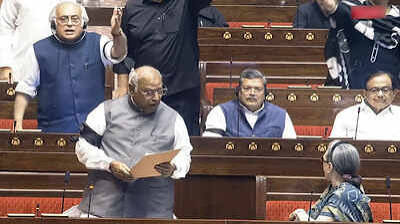
The Lok Sabha and the Rajya Sabha witnessed stormy sessions yet again on Thursday with the Opposition members insisting on demands for Education Minister Dharmendra Pradhan’s resignation and debate on NEET paper leak in Parliament. There has been a sharp exchange of words between the opposition leaders and the ruling MPs. Parliament witnessed a stormy start following heavy sloganeering and protests by Opposition members over the alleged irregularities in the NEET-UG examination.
Government blames Congress for delay in decision
Parliamentary Affairs Minister Kiren Rijiju stated that while the government is fully prepared to discuss the NEET issue, the Opposition is deliberately stalling the process by imposing pre-conditions. “All parties have demanded that NEET be discussed. Today, the entire NDA party has again demanded that NEET be discussed. I felt that yesterday, after meeting with Kharge ji and some other opposition leaders, we had a little hope that a discussion could take place today. The Congress party imposed a condition. We requested that we decide among ourselves how and for how long the discussion would proceed but don’t impose conditions. Your intention to impose conditions is not correct because you want to stop the discussion. We are again requesting that the NEET exam be discussed thoroughly in both Houses, without any politicisation,” said Rijiju.
Rijiju further said that Prime Minister Narendra Modi has also taken a very strong step and informed the country that judicial fast-track courts should be established so that if any incident occurs in the country, the harshest punishment can be given as soon as possible.
Congress accuses govt of runnin away from debate
On Parliamentary Affairs Minister Kiren Rijiju’s statement, Congress MP Rajeev Shukla said, “The opposition isn’t shying away from the debate. The opposition has been saying very clearly from day one that you should get the education minister to resign and hold a discussion on the matter. The government is running away from that. I don’t know why they aren’t forcing the resignation. People have taken to the streets. Millions of people are upset”
In a sharp rebuttal, Leader of Opposition in the Rajya Sabha, Mallikarjun Kharge, termed the Prime Minister’s remarks as ‘instigative’ and accused the government of failing to take accountability for the paper leak. “Today, the Prime Minister has made a statement. This is an instigative statement. The Education Minister should resign; only then will we be ready to have a discussion,” he said.
Rule 176 vs Rule 267: What is the difference?
Rule 176 of the Rajya Sabha governs short-duration discussions, allowing any member to submit a written notice backed by at least two signatures to raise a matter of urgent public importance. Designed to ensure legislative work continues without major disruption, this mechanism is tightly regulated with a strict time cap of a maximum of two and a half hours for the entire debate. It does not involve a formal motion or voting, making it the preferred format for governments because it facilitates accountability and addresses pressing issues while keeping the day’s standard legislative agenda intact.
Rule 267 is an extraordinary provision in the Rajya Sabha that empowers a member, with the Chairman’s consent, to move for the suspension of regular rules and halt all pre-decided business listed for the day. When invoked successfully, it clears the entire schedule to immediately prioritise and thoroughly debate a singular, critical national crisis. Because it completely disrupts routine legislative functioning and carries immense political weight, it is frequently pushed by the opposition to signal utmost urgency, though its strict application remains a frequent point of contention in Parliament.
Bureau Report
Leave a Reply