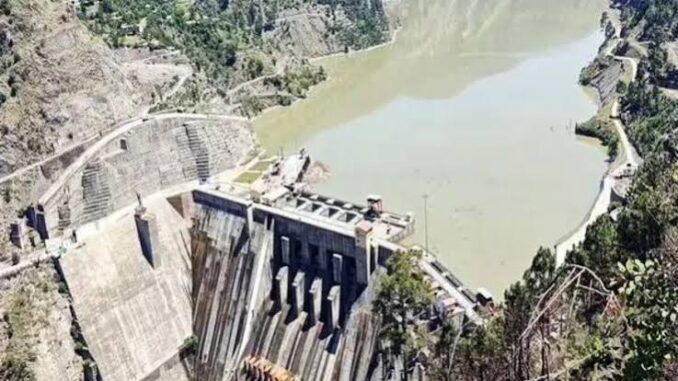
It has been over a year when India suspended the Indus Water Treaty following the brutal Pahalgam terror attack backed by Pakistan. Since then, India has maintained that the treaty cannot function on decades old terms and if an agreement has to be made, it will be on new terms as agreed by New Delhi. India’s strategic shift regarding the Indus Waters Treaty (IWT) reflects a calculated break from six decades of strategic restraint. Placed in abeyance following the Pahalgam terror attack, the 1960 pact is now viewed by Indian policymakers as fundamentally obsolete.
The IWT had granted significant concessions to Pakistan. Although the Indus river system originates largely in territories under India’s control, the agreement allocated Pakistan rights over the three western rivers—the Indus, Jhelum and Chenab—which together comprise nearly 80 per cent of the Indus basin’s total water.
Against the backdrop of Pakistan’s international campaigns—attempting to frame New Delhi’s actions as a threat to its 240 million citizens—India is aggressively accelerating infrastructure development on the Chenab River while establishing a firm legal and diplomatic doctrine. This analysis examines how India is bypassing Islamabad’s global rhetoric through domestic hydro-capitalization, legal justifications under customary international law, and a non-negotiable security threshold.
1. Strategic Acceleration on the Chenab
India is prioritizing the rapid completion of major hydroelectric schemes to maximize its entitled share under the Indus basin framework. Rather than waiting for diplomatic stalemates to clear, New Delhi is fast-tracking a portfolio exceeding 5,000 megawatts:
Key Projects Underway: The 1,856 MW Sawalkote, 1,000 MW Pakal Dul, 850 MW Ratle, 624 MW Kiru, and 540 MW Kwar hydroelectric initiatives.
Timeline: The Kiru and Pakal Dul projects are slated for completion within the year, with the remaining infrastructure scheduled to come online over the next two to three years.
Dual Utility: These assets directly serve India’s domestic goals of grid stability, regional socio-economic development, and meeting national clean-energy transition targets, while fully exercising its legal water rights.
2. Countering Pakistan’s Narrative of Manufactured Victimhood
Pakistan has actively sought global sympathy, characterizing India’s suspension of the pact as an “unlawful” existential threat to regional water security. India counters this narrative by reframing the core problem from water scarcity to systemic domestic mismanagement within Pakistan:
The Inefficiency Factor: Under the original treaty allocation, Pakistan receives roughly 80% of the Indus Basin waters. However, vast quantities are lost annually to unchecked surface runoff.
Lack of Infrastructure Investment: Authorities point out that Islamabad has failed to construct a single large-scale water storage project or invest in modern basin management systems since 1976.
Continued Humanitarian Responsibilities: Even with the treaty suspended, India continues to uphold basic humanitarian protocols, such as transmitting routine flood warnings to protect civilian lives and property across the border.
3. The Legal and Diplomatic Doctrine
India’s recalibration is anchored in a firm legal logic that challenges the inviolability of the 60-year-old pact:
Goodwill Unreciprocated: For decades, New Delhi adhered to the letter and spirit of the agreement through wars and military crises, whereas Pakistan maintained a continuous policy of cross-border terrorism.
Customary International Law: Although neither India nor Pakistan is a party to the Vienna Convention on the Law of Treaties (VCLT), India relies on Article 60 frameworks via customary international law. New Delhi argues that state-sponsored terrorism constitutes a fundamental material breach, releasing an affected sovereign state from its treaty obligations.
The Threshold Condition: Officials maintain there is no fixed timeline for the suspension. The IWT will remain frozen indefinitely until Pakistan verifiably and permanently ends its support for UN-sanctioned terrorist networks operating near the Line of Control. Any future water-sharing arrangement will require entirely new parameters, rendering the old agreement permanently defunct.
India has maintained that the future of the Indus Waters Treaty (IWT) hinges on Islamabad’s readiness to build genuine trust, abandon terrorism as an instrument of state policy, and pursue constructive engagements with India.
Bureau Report
Leave a Reply