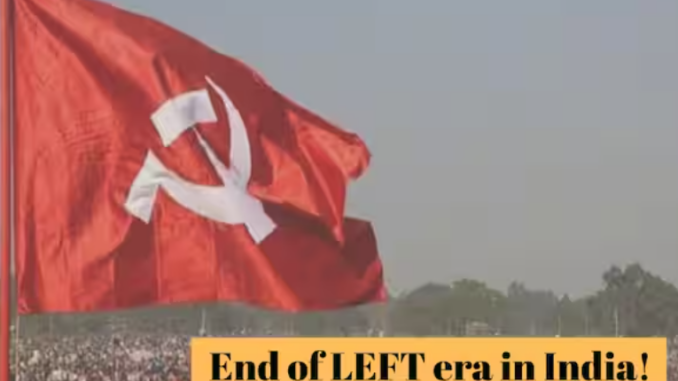
Kerala: With Left’s loss imminent in Kerala, a landmark political shift signals the twilight of an ideological era, India’s Left parties, long associated with communist governance, appear to have lost their final bastion of state power. With counting underway for the 2026 Kerala Assembly elections, trends strongly suggest the ouster of the CPI(M)-led Left Democratic Front (LDF) after a decade in power.
In a wider context, this would leave no major state under Left rule for the first time in 49 years, marking what can be describe as the decimation of organized communism in Indian politics.
From revolutionary roots to regional strongholds
Communism in India traces its origins to the 1920s, with the Communist Party of India (CPI) formally founded in 1925, inspired by the Bolshevik Revolution, played roles in anti-colonial struggles but often operated underground or faced bans.
Post-independence, the movement split, most notably in 1964 with the formation of the CPI(Marxist) or CPI(M), amid ideological differences over China, the Soviet Union, and parliamentary participation.
The Left’s golden age: From Kerala, West Bengal to Tripura
In Kerala, the world’s first democratically elected communist government formed in 1957 under E.M.S. Namboodiripad. After alternating with the Congress-led United Democratic Front (UDF) for decades, the LDF secured power in 2016 and retained it in 2021, seeking an unprecedented third consecutive term in 2026.
In West Bengal, the Left Front ruled continuously for 34 years from 1977 to 2011, implementing land reforms and empowering rural panchayats, though later criticized for industrial stagnation and events like the Singur and Nandigram controversies. The era ended dramatically with Mamata Banerjee’s Trinamool Congress (TMC) victory in 2011. Interestingly TMC faces similar ouster after 15 years of dominance in Bengal.
Similar to Kerala and West Bengal, Tripura saw Left rule for over 25 years until the BJP’s rise in 2018.
Smaller pockets of influence persisted in states like Andhra Pradesh and Bihar historically, but national parliamentary strength dwindled from significant numbers in the mid-20th century to marginal seats today.
What went wrong?
The ideological rigidity and failure to adapt, the Indian Left parties clung to classical Marxist frameworks while much of the world, including China and Vietnam, embraced market reforms. This rigidity made them resistant to liberalization, privatization, and globalization, alienating aspirational voters and industries.
Loss of Traditional Bases: Land reforms succeeded early but later governance faced accusations of nepotism, violence, and economic underperformance.
Urban and youth migration shifted priorities toward jobs, infrastructure, and development over class struggle rhetoric.
Rise of regional and identity-based parties fragmented the Left’s working-class and minority support.
Electoral marginalization in recent years: In the 2024 Lok Sabha polls, CPI(M) won just four seats and CPI two, modest numbers that underscored their shrinking footprint. Now without state power as a platform for policy experiments, influence will further eroded.
Internal challenges
Apart from ideological rigidity, the left in India also suffered from factionalism, aging leadership, and failure to counter narratives from the biggies like BJP on nationalism or from regional players on welfare and development fueled Left’s erosion.
Kerala’s verdict: The last domino falls
Kerala, long seen as the Left’s model state with high human development indices, became their final redoubt after losses in West Bengal and Tripura.
Pinarayi Vijayan’s government highlighted welfare schemes, education, and health, but faced anti-incumbency over issues like unemployment, fiscal strain, and governance fatigue. With LDF’s defat a decade of Left rule and leaving India without any Left-led state government.
From ruling multiple states simultaneously, the Left is now confined to opposition roles and pockets of local influence.
Broader implications for Indian politics
For National Discourse, Leftist ideas on inequality and secularism may persist intellectually, but organized parliamentary communism faces existential questions.
Some economic policies, like welfare emphasis have been adopted across the spectrum.
The BJP has captured nationalist and development-oriented voters; regional parties fill other voids.
Now Left’s survival may depend on alliances, ideological renewal, or focusing on movements rather than governance. A century after its founding, Indian communism confronts a profound identity crisis.
With vote counting underway, the ‘Red Map’ of India may turn blank at the state level for the first time in modern history, closing a chapter that began with revolutionary zeal and endured through democratic persistence.
Leave a Reply