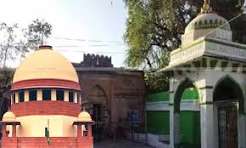
The Supreme Court of India has refused to stay the Madhya Pradesh High Court’s verdict declaring the disputed Bhojshala-Kamal Maula Mosque complex in Dhar as a Hindu temple. However, the apex court directed the Madhya Pradesh government to provide a separate open space near the monument for members of the Muslim community to offer namaz on Fridays between 1 pm and 3 pm as an ad hoc arrangement. The apex court declined to grant interim permission to the Muslim side to offer Friday namaz inside the Bhojshala premises, effectively allowing the MP High Court’s ban on prayers within the protected complex to continue.
A Bench of Chief Justice of India (CJI) Surya Kant and Justices Joymalya Bagchi and V. Mohana directed that the interim arrangement would be ‘without prejudice to the rights of both sides’. The bench said that the interim arrangement would remain subject to the final outcome of the special leave petitions (SLPs) against the High Court’s verdict.
“Without prejudice to the rights of both sides, it is directed that a separate open space adjacent/near to the subject premises may be provided to the appellant and other members of the community for offering namaz on Friday between 1-3 PM. It shall be ensured that no disturbance is caused from both sides in performance of religious affairs. Arrangement shall be ad-hoc in nature and subject to final outcome of the present proceedings,” the CJI Kant-led Bench ordered.
Key highlights from the SC order:
No Permission for Namaz Inside the Complex: Permission has not been granted for namaz (prayer) inside the Bhojshala complex. The Supreme Court (SC) has directed that a space be arranged for namaz near the complex instead.
Continuation of Worship: In the Bhojshala case in Dhar, Madhya Pradesh, worship (puja-archana) will continue as it currently is. The Muslim community will not be allowed to offer namaz inside the Bhojshala complex.
SC Refusal: The Supreme Court refused to stay the order of the Madhya Pradesh High Court. The Muslim side had requested that the status quo prior to the High Court’s order be restored, but the Supreme Court declined this request.
Arrangement for Friday Prayers: The SC has directed the government to provide a space near the Bhojshala complex for offering namaz every Friday. The prayers will be held between 1:00 PM and 3:00 PM.
Temporary Arrangement: The SC stated that this will remain a effect until a final court verdict is reached in this matter. This means that the manner in which worship is currently being conducted will continue, and the Archaeological Survey of India (ASI) will not make any changes to the structure of the Bhojshala complex.
No Structural Changes: The SC has instructed the ASI not to make any changes to the Bhojshala building without the court’s permission.
Notice Issued: The Supreme Court has issued notices to the Hindu side and the state government regarding the petition filed by the Muslim side. The court will hear the matter again in three weeks.
The matter is expected to be listed again after two to three weeks.
The Supreme Court also issued notices on the SLPs filed by the Muslim side to the Centre, the Madhya Pradesh government, the ASI, the District Magistrate concerned and the Hindu respondents, seeking their responses.
The Muslim side has challenged the May 15 judgment of the Indore Bench of the Madhya Pradesh High Court, which recognised the Bhojshala complex as a Hindu temple and held that the Hindu community’s right to worship at the site “was never extinguished”.
The High Court had quashed the Archaeological Survey of India’s April 7, 2003 order permitting Muslims to offer namaz on the premises on Fridays, holding that the arrangement was inconsistent with the established religious character of the monument.
It had ruled that exclusive worship rights would remain with the Hindu side while suggesting that the state government consider allotting alternative land to the Muslim community for the construction of a mosque.
Bureau Report
Leave a Reply