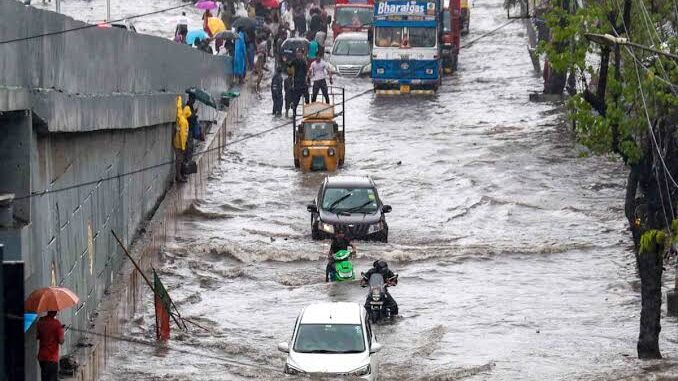
ncessant rainfall over the past week has severely disrupted normal life across Maharashtra, triggering flood-like situations in several districts. Rivers, streams, and local water bodies are overflowing, cutting off connectivity and submerging low-lying areas. While the India Meteorological Department (IMD) maintains active alerts for multiple regions, weather experts have indicated that the monsoon’s intensity is expected to recede starting Wednesday, leaving light to moderate showers confined primarily to the Konkan coast and the ghat (mountainous) regions.
Despite indications of a weakening monsoon system, the IMD has issued alerts for several parts of the state due to localised vulnerabilities. The coastal districts of Palghar, Raigad, and Ratnagiri remain under a yellow alert, with forecasts predicting heavy to very heavy rainfall in isolated spots.
Mumbai received a brief but intense overnight downpour that caused severe waterlogging in areas such as Worli Village, but the city experienced a temporary respite by morning. Road transport continues to operate normally, though suburban railway services reported minor delays — Central Line trains are running about 5 minutes late, while Harbour and Trans-Harbour lines are facing delays of up to 10 minutes. The IMD has forecast moderate rainfall throughout the day.
Extreme caution has been advised for the ghat regions of Pune and Satara, where very heavy rainfall is continuing. In contrast, Pune city is expected to receive only light to moderate showers. The districts of Kolhapur (ghat areas under yellow alert), Sangli, Solapur, and Satara are likely to see light rain.
Thunderstorms accompanied by lightning and gusty winds are highly likely in Akola, Amravati, Buldhana, and Wardha. Moderate rainfall spells will persist across Dhule, Nandurbar, Jalgaon, and Nashik. The Nashik ghat areas remain under a yellow alert.
Officials stated that a severe cloudburst threat had initially developed over Nashik, but the dense cloud mass shifted towards Palghar and Gujarat, thereby averting major catastrophe. The continuous heavy rainfall over the past five days has significantly raised water levels in the state’s reservoirs, shifting the focus to flood management.
Officials stated that a severe cloudburst threat had initially loomed over Nashik, but the dense cloud mass shifted towards Palghar and Gujarat, thereby averting major catastrophe. The continuous heavy rainfall over the past five days has significantly raised water levels in the state’s reservoirs, shifting the focus to flood management.
Relentless rain in the catchment areas has rapidly filled Pune’s major water reservoirs. The Khadakwasla Dam has reached its full capacity, leading authorities to release water into the Mutha River at a high rate of 27,000 cusecs, up from the earlier discharge of 22,880 cusecs. As a result, Pune’s low-lying Baba Bhide Bridge has been completely submerged.
Floodwaters have entered residential areas, inundating houses in Ekta Nagar Society. Local administration teams are carrying out relief operations, while Pune Mayor Manjusha Nagpure has been personally inspecting vulnerable locations such as Rajput Nagar, Pulachiwadi, and Nimbanagar since early morning to oversee evacuation efforts. The four dams in the Khadakwasla circle collectively hold 14 TMC of water, which is approximately 48% of their total storage capacity.
In Alandi, a major pilgrimage site, the Indrayani River has breached its banks. All four primary bridges spanning the river are submerged under floodwaters, paralysing local transport and causing significant structural and property damage in adjacent neighbourhoods.
While western parts of the state drown, the Marathwada region is still waiting for definitive relief. The crucial Jayakwadi Dam logged a fresh inflow of 1,493 cusecs over the last 24 hours, bringing its useful water stock to 28.24 per cent. Despite the inflow, this is significantly lower than the 49.65 per cent storage recorded on the same date last year, emphasising Marathwada’s ongoing struggle with an uneven monsoon distribution.
Intermittent disruptions continue to plague the state’s transport networks. In the Varandha Ghat section, a massive landslide occurred while clearance operations for a previous debris fall were actively underway. A team of highway officials and labourers narrowly escaped a fatal accident as a fresh patch of the hillside gave way. Work was temporarily halted to evaluate structural stability before being resumed under strict safety guidelines.
In Eastern Maharashtra, a dry June had left the agrarian community on the brink of distress due to El Niño anxieties. However, after a brief two-day lull, intense evening showers lashed the Bhandara district, including the Tumsar taluka. The fresh precipitation has restored agricultural operations, allowing local farmers to fast-track delayed paddy transplantation.
Bureau Report
Leave a Reply