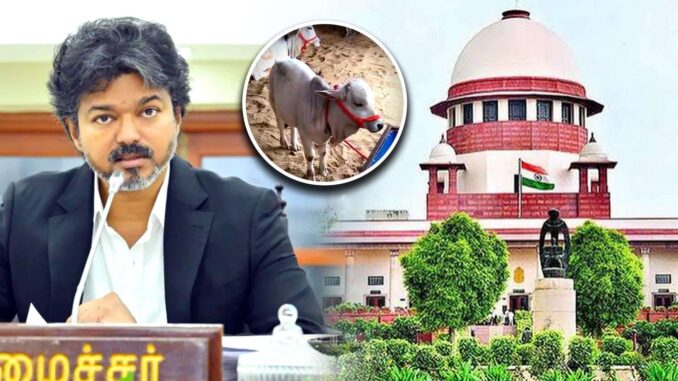
In a major legal victory for Chief Minister Vijay’s newly formed Tamil Phazhagai Kazhagam (TVK) government, the Supreme Court of India on Monday issued an interim stay on a Madras High Court order that had imposed a complete, state-wide ban on the slaughter of cows and calves across Tamil Nadu.
A division bench comprising Justice Vikram Nath and Justice Sandeep Mehta passed the stay order while issuing a formal notice to the original petitioner on a Special Leave Petition (SLP) filed by the Tamil Nadu state administration. The apex court noted that the final operative paragraph of the High Court’s directive, which established the blanket ban, appeared to require significant structural “correction.”
Technical Layout of the State’s Appeal
The high-stakes legal battle stems from a Madras High Court order passed on May 27. The order had directed the state’s Chief Secretary and Director General of Police (DGP) to ensure that no cow or calf was slaughtered anywhere in Tamil Nadu, either on the eve of the Bakrid festival or on any other day moving forward.
[Madras HC Hears PIL Restricting Open Slaughter to Authorized Houses]
│
[HC Issues Contradictory Final Order: Imposes Absolute, State-Wide Ban]
│
[CM Vijay’s TVK Government Challenges Order Under Existing 1958 State Law]
│
[Supreme Court Stays Ban: Restores Validity of Tamil Nadu Preservation Act]
In its petition to the top court, the TVK government exposed a glaring contradiction within the High Court’s ruling. While the High Court had correctly stated that animal slaughter must strictly be restricted to designated, state-licensed slaughterhouses, it immediately contradicted itself by declaring an absolute prohibition on the slaughter of cows under any circumstances, effectively bypassing existing state legislation.
Conflict Over Statutory Age Limits and the 1958 Act
The Madras High Court had justified its blanket prohibition by relying heavily on a 1976 judicial precedent, which banned cow slaughter to protect regional milk production and stabilize the agrarian economy. However, the Tamil Nadu government successfully argued that this judicial overreach directly violated the statutory provisions of the Tamil Nadu Animal Preservation Act, 1958.
The Statutory Framework: Under the current provisions of the 1958 Act, the slaughter of cows is not entirely banned. The law explicitly permits the slaughter of cows over the age of 10 years, provided they are certified by a competent authority as no longer fit for work, breeding, or milk production.
Comparative Adjudication Matrix
Judicial Parameter Madras High Court Directive (May 27) Supreme Court Intervention & State Law
Scope of Prohibition Imposed a total, permanent state-wide ban on cows/calves for Bakrid or any other day. Stayed. Restores the legal status quo and prevents immediate executive overreach.
Slaughterhouses Restricted all livestock processing strictly to state-authorized facilities. Upheld. Both sides agree slaughter cannot happen in unauthorized open public spaces.
Statutory Validity Bypassed the Tamil Nadu Animal Preservation Act, 1958 in favor of a 1976 precedent. Reinstated. Reaffirms that cows past the age of 10 can be legally processed with proper certification.
The original High Court case was triggered by a Public Interest Litigation (PIL) filed by K. Surya Prasanth, the General Secretary of the Hindu Makkal Katchi. While the petition initially only sought to halt illegal slaughter outside of designated municipal slaughterhouses, the High Court expanded the scope into a sweeping ban. By staying this order, the Supreme Court has protected the legislative powers of the state government, defusing a highly sensitive political and administrative crisis for the Vijay-led TVK administration.
Bureau Report
Leave a Reply