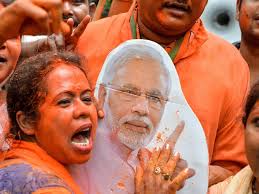
After one month of continuous campaigning, rallies and election procedure, it is finally that time of the year when any one party, whether the Trinamool Congress or the Bhartiya Janata Party, will claim the Bengali empire after the May 4 results. But before that, the Exit polls on Wednesday have given a smaller picture of what is going to happen in the future. The exit polls have predicted an edge for the BJP over Mamata Banerjee’s TMC in the state, which, if it comes true, will help the saffron party to form a government for the first time in Didi’s kingdom.
The BJP has billed this election as a make-or-break battle for the party. Since 2014, the BJP has been attempting to breach Mamata’s fortress. Four exit polls predict the BJP might be able to do this year, giving it anywhere between 146 and 175 seats.
Two pollsters have projected a fourth consecutive term for the Trinamool Congress in West Bengal. People’s Pulse has forecast 177 to 187 seats for the party, while Janmat Polls goes further, predicting 195 to 205 seats, a thumping majority for a party that has now been in power for 15 years.
The BJP’s journey in Bengal has been anything but gradual. From just three assembly seats in 2016, the party climbed to 77 of the 294 seats within five years, securing 38.1 per cent of the vote in 2021 and firmly establishing itself as the principal opposition.
This time, the party threw everything at Bengal. Prime Minister Narendra Modi criss-crossed the state, holding over 20 rallies, visiting temples, and even stopping for a plate of jhalmuri, Bengal’s beloved street snack, in a visible bid to connect with local voters. Home Minister Amit Shah went further still, camping in the state for 15 days straight.
However, the factor BJP leaders are banking on most is the Special Intensive Revision of electoral rolls, which resulted in the deletion of 91 lakh names from the voter list. The party believes the mass exclusion will hurt the Trinamool Congress, whose support base it expects to be disproportionately affected.
The other factors that could have led to the victory of the BJP in the state are the ‘women’s vote’. The BJP made a very sharp strategy to win the ‘mahila voters’ who form one of the most decisive and consistent electoral forces in the state. The state has over 6.75 crore voters, of whom 3.44 crore are women, and 3.60 crore are men. The ‘mahila’ of the state makes the electorate decisive in closely contested elections.
At rallies in Purba Bardhaman and Murshidabad, the Prime Minister also gave a clear message focusing on the women voters that once the BJP wins, the women in the state will be safe, the law and order will improve, and every woman’s right will be safeguarded. While speaking at a rally here, the PM said, “I have especially come to assure all the sisters and daughters of Bengal. BJP has announced Rs 3,000 per month for women.”
The promise of Rs 3,000 per month sits at the heart of the BJP’s pitch to women voters, framed deliberately as double what the state government currently provides, turning the contest into a direct welfare comparison between Delhi and Nabanna.
But the outreach stretched well beyond cash transfers. The Lakhpati Didi scheme, launched in 2024, is a central government flagship aimed at making three crore women financially independent by enabling them to earn over Rs 1 lakh annually. The BJP has pointed to a real-world precedent to back its welfare argument, the Mukhyamantri Majhi Ladki Bahin Yojana in Maharashtra, which provides Rs 1,500 monthly to women and is widely credited with delivering the BJP-led Mahayuti alliance its commanding victory in the 2024 state polls.
The messaging has been given sharper emotional edges on the ground. At a rally in Birbhum, Prime Minister Modi framed the Bengal election as a fight for women’s dignity and safety, invoking the RG Kar Medical College rape and murder case. “This election is for the dignity and honour of our daughters and women,” he said.
The candidate selection has reinforced that message. In Panihati, the BJP has fielded Ratna Debnath, the mother of the RG Kar victim, lending the campaign a symbolic weight that no slogan could replicate. In Cooch Behar, Modi went further, promising 33 per cent reservation for women in Parliament and state assemblies from 2029.
Taken together, the BJP has built a three-part pitch to Bengal’s women voters: cash, safety and representation, each element reinforcing the other.
The BJP is betting that voter priorities in Bengal have shifted in ways that cannot be reversed. Senior leaders, most notably Suvendu Adhikari, have repeatedly argued that incidents like the RG Kar rape and murder and the Sandeshkhali sexual assault allegations have fundamentally altered how women in the state perceive their own safety under the current government. The central argument is pointed out that Bengal’s women remain unsafe despite being governed by a woman chief minister, and that these incidents are not isolated failures but evidence of a deeper rot.
Whether the BJP’s arrow will find its mark or fall short is a question that now lingers just days away from an answer. All eyes are on May 4 to see if the “saffron fever” has finally reached a breaking point, or if Mamata Banerjee’s grassroots fortress remains truly impenetrable.
Bureau Report
Leave a Reply