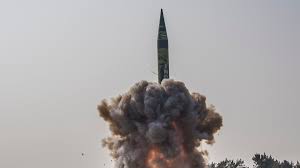
NewDelhi: India has achieved a major milestone in its strategic weapons programme by joining a select group of nations that possess Multiple Independently Targetable Re-entry Vehicle (MIRV) capability, a technology that allows a single ballistic missile to deliver several nuclear warheads to different targets in a single strike. The achievement places India among an extremely limited set of countries that have developed and operationalised this advanced system, which plays an important role in modern nuclear deterrence doctrines.
The United States was the first country to introduce operational MIRV systems in 1970 with the deployment of the Minuteman III ICBM. More than five decades later, India has reached this technological threshold through indigenous efforts led by the Defence Research and Development Organisation (DRDO).
The breakthrough emerged through the Agni-5 programme under Mission Divyastra, followed by a series of validation trials extending into 2026 that confirmed the stability and precision of multiple warhead deployment from a single missile platform.
A demonstration came during the May 2026 test conducted from the strategic launch complex at Dr APJ Abdul Kalam Island. The advanced version of the Agni-5 executed a complex sequence involving the separation of multiple payloads, each guiding independently toward dispersed targets across the Indian Ocean region.
This test built upon the earlier landmark Mission Divyastra flight of March 2024, which first demonstrated India’s ability to integrate MIRV architecture into its long-range ballistic missile systems.
Developed entirely within India’s indigenous defence ecosystem, the Agni-5 programme is the result of years of research in propulsion systems, re-entry vehicle design, miniaturised warhead integration and precision guidance technologies.
The system is intended for ranges exceeding 5,000 kilometres and is engineered to deliver multiple independently targetable warheads, giving it the ability to engage several high-value targets in a single launch sequence. This capability enhances operational flexibility within India’s strategic deterrence doctrine.
The international MIRV club is extremely restricted. It comprises the United States, Russia, France, the United Kingdom, China, India and Pakistan. Based on declared timelines, the United States initiated operational deployment in 1970, followed by Russia in 1975, France in 1985, the United Kingdom in 1994, China in 2015, India in 2025 and Pakistan in 2017.
India’s progress has been driven by sustained indigenous development under restrictive technology regimes, where access to advanced missile technologies was limited for decades. The evolution of the Agni-5 system shows long-term investments in materials science, guidance electronics and re-entry vehicle separation systems developed within national laboratories and research institutions.
Pakistan’s Ababeel medium-range ballistic missile has been presented as a system built to counter regional missile defence networks and is associated with claimed MIRV capability. Since its announcement in 2017, multiple reported test attempts have faced performance challenges, with open-source assessments pointing to issues related to propulsion stability and structural reliability during flight trials, including reports extending into mid-2025.
The Agni-5 equipped with MIRV capability strengthens India’s ability to maintain credible minimum deterrence by complicating interception strategies and increasing the number of potential targets that can be engaged in a single mission profile. The system enhances strategic depth by enabling multiple simultaneous strike options while reducing reliance on single-warhead configurations.
With continued testing and operational validation, the Agni-5 is moving toward full integration within the Strategic Forces Command. The development shows a trajectory of technological self-reliance in India’s defence sector and places the country among the world’s most advanced missile-capable states in the field of strategic delivery systems.
Bureau Report
Leave a Reply