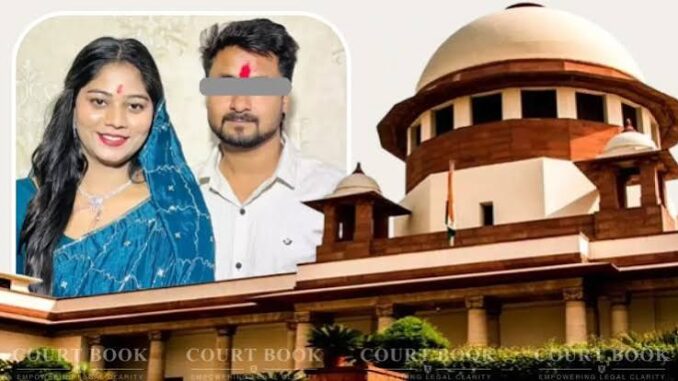
The Supreme Court on Friday refused to send Sonam Raghuvanshi, the main accused in the alleged murder of her husband Raja Raghuvanshi during their honeymoon in Meghalaya last year, back to jail for the time being, while expressing reservations about the Meghalaya High Court’s order granting her bail.
A bench comprising Justices MM Sundresh and Sheel Nagu admitted the Meghalaya government’s appeal challenging the Meghalaya High Court’s June 29 judgment granting bail to Sonam Raghuvanshi. The court issued notice to Sonam but refused to stay the bail order after learning that she had already been released.
“Prima facie, we would have stayed the bail order, but since she has already been released, we would not want to intervene,” the bench observed and posted the matter for further hearing on July 9.
The Supreme Court noted that it was not impressed with the reasoning of the High Court, but was equally mindful of the serious consequences of sending an accused back to prison after she had been released on bail.
“We are conscious that howsoever grave the alleged offence is, there is a presumption of innocence,” the bench said. It added that it would consider passing appropriate orders to expedite the trial after Sonam files her response.
The case pertains to the murder of 29-year-old Indore businessman Raja Raghuvanshi, who had travelled to Meghalaya on honeymoon with Sonam after their marriage in May 2025. The couple went missing after checking out of a homestay in Nongriat on May 23. Raja’s body was later recovered from a gorge near Weisawdong Falls in Sohra, while Sonam was traced a few days later in Uttar Pradesh.
On Friday, the Meghalaya police, represented by Solicitor General Tushar Mehta, argued that the murder was “shocking” and “premeditated”. They contended that the High Court had erred in granting bail, which was primarily based on a typographical error in the arrest documents.
“The wife travels to Meghalaya with three accomplices. She participates in assaulting the husband…the husband is killed, and the body is thrown in a forest. She later absconded and was arrested in Uttar Pradesh,” Mehta submitted.
Solicitor General Tushar Mehta told the bench that Sonam’s bail had been rejected on three previous occasions, with the courts recording prima facie evidence pointing to her involvement in the murder.
Mehta contended that the High Court granted her bail solely due to a clerical mistake in the arrest documents, which erroneously referred to Section 403 of the Bharatiya Nyaya Sanhita (BNS) instead of Section 103, the provision that deals with murder.
“There was just one typographical error where Section 103 was mentioned as 403 under the BNS,” he submitted. Relying on the Supreme Court’s recent ruling in the Darshan case, he argued that procedural lapses can justify relief only when they cause actual prejudice to the accused.
Bureau Report
Leave a Reply