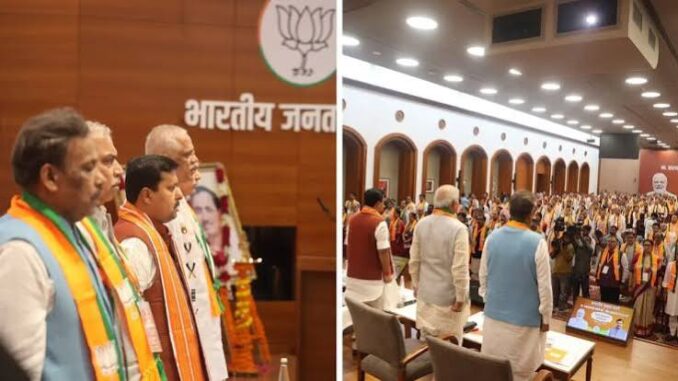
The BJP on Saturday passed a resolution backing the full six-stanza version of Vande Mataram and announced a nationwide campaign on its history and significance. The move comes after the Congress Working Committee decided to retain its 1937 position of restricting party-event recitations to the song’s first two stanzas.
BJP targets Congress decision on Vande Mataram
The BJP said it strongly opposes the Congress Working Committee decision of August 19. According to the BJP resolution, limiting the song to two stanzas undermines what the party describes as its historical and national significance.
The BJP said Vande Mataram represents reverence for Bharat Mata and played an important role in India’s freedom movement. The party also described it as a symbol of national consciousness.
The resolution said the BJP would oppose the Congress position and seek to protect what it called the honour and legacy of the complete six-stanza song.
What the BJP resolution says
The party has outlined several steps in response to the Congress decision.
- Oppose the restriction of Vande Mataram to its first two stanzas at Congress events.
- Promote awareness of the history and meaning of the full six-stanza song.
- Reaffirm the Constituent Assembly’s 1950 position on Vande Mataram.
- Highlight the 2026 parliamentary law referred to in the BJP resolution as giving the National Song statutory protection at par with Jana Gana Mana.
- Oppose attempts to link the status of the National Song to communal or electoral considerations.
- Conduct a nationwide campaign, including special programmes aimed at young people.
BJP plans nationwide Vande Mataram awareness drive
The BJP said its workers will take the history and significance of Vande Mataram to people across the country. The party said a special focus would be placed on young people so that future generations understand the song’s connection with the freedom movement.
According to the resolution, the campaign will also examine the historical circumstances surrounding restrictions on the song, including objections raised by the Muslim League and the wider politics of communal and separatist demands.
The BJP also plans to highlight Mahatma Gandhi’s description of Vande Mataram as an “anti-imperialist slogan” linked to the “purest national sentiment.”
BJP invokes 1937, 1950 and 2026 decisions
The political dispute has its roots in different decisions taken over several decades. The BJP resolution argues that the Congress position adopted in 1937 cannot override later constitutional and parliamentary decisions.
The party said the Constituent Assembly’s 1950 declaration and the parliamentary law passed in 2026 should guide the treatment of the National Song. The BJP also said a party resolution cannot take precedence over the Constitution or a law enacted by Parliament.
The resolution further accused Congress of allowing political considerations to influence its position on Vande Mataram. Those claims represent the BJP’s political position.
Congress sticks to first two stanzas
The Congress Working Committee decided on August 19 that only the first two stanzas of Vande Mataram would be sung at party programmes. Congress said it was following the position associated with decisions taken by Mahatma Gandhi, Jawaharlal Nehru and Sardar Vallabhbhai Patel in 1937.
Congress MP KC Venugopal said after the CWC meeting that the party’s position on the recitation of Vande Mataram remained clear and that it would follow the 1937 decision.
Row followed Independence Day controversy
The latest dispute followed a political confrontation over an Independence Day event on August 15. The BJP had accused Congress president Mallikarjun Kharge and party parliamentary chairperson Sonia Gandhi of speaking to each other while Vande Mataram was being performed.
The BJP demanded an apology over the incident. Congress later reiterated its position on how the song should be recited at its programmes.
BJP links Vande Mataram to freedom movement
The BJP resolution places strong emphasis on the song’s role in the freedom struggle. It said the British authorities had sought to suppress the words because they helped inspire resistance to colonial rule.
The party said Vande Mataram was associated with the independence movement in 1947 and linked its political message to Prime Minister Narendra Modi’s vision of a developed India by 2047.
The BJP said the issue should be viewed as one concerning national honour and the legacy of people who contributed to India’s freedom struggle, rather than only as a dispute between political parties.
What happens next
The BJP’s nationwide campaign is expected to bring the Vande Mataram debate to party programmes, public outreach events and youth-focused activities. The Congress, meanwhile, continuesto defend its decision to follow the 1937 position on the song’s recitation.
Bureau Report
Leave a Reply