The death toll in Friday’s terrorist attack on migrant labourers in South Kashmir’s Kulgam district rose to two on Saturday after the second injured worker succumbed to his injuries at the Sher-i-Kashmir Institute of Medical Sciences (SKIMS) in Srinagar.
Kulgam terror attack death toll rises to two
Terrorists opened fire on two non-local labourers working at a brick kiln in the Kelam area of Kulgam on Friday evening. Both workers suffered critical injuries and were rushed to Government Medical College (GMC), Anantnag, for treatment.
One of the injured labourers died at GMC Anantnag. The second worker was later referred to SKIMS Srinagar for advanced treatment but died on Saturday despite efforts by doctors.
Two Chhattisgarh labourers killed in Kulgam attack
The deceased have been identified as Deepak Rattray, 24, son of Uma Shankar, and Bopinder, 28, son of Dasrar. Both were residents of Chhattisgarh and had travelled to Kashmir for work as migrant labourers.
Sources claimed that the attackers selectively targeted the non-local workers after checking their identity cards. However, police denied that such an incident had taken place.
Security forces launch search operation
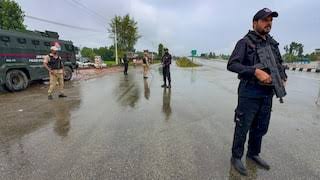
Security forces quickly reached the attack site, cordoned off the area and launched a large-scale search operation to track down the attackers.
Police have registered a case and an investigation is underway.
TRF claims responsibility for attack
The Resistance Front (TRF), widely regarded as an offshoot and proxy of the Pakistan-backed Lashkar-e-Taiba (LeT), has claimed responsibility for the attack.
According to messages circulating on social media, the group warned of further attacks against non-locals and Jammu and Kashmir Police personnel. Reports also suggest that the same group was involved in the killing of a police officer in Anantnag on July 22.
Recent attacks on non-locals and security personnel
The Kulgam attack is the second major terror strike in the Kashmir Valley within around ten days.
On July 22, terrorists shot dead Jammu and Kashmir Police Head Constable Ashiq Hussain Qureshi at point-blank range in the Lal Chowk area of Anantnag. The attack took place in a busy market area located along the Amarnath Yatra route.
Targeted killings raise fresh security concerns in Kashmir
The back-to-back attacks have raised concerns about the return of targeted killings of security personnel and non-local civilians in Kashmir. Such incidents had declined significantly in recent years following intensified security operations and a reduction in overall terror activity after the abrogation of Article 370.
For several years, the Valley witnessed relatively fewer attacks on migrant workers and police personnel compared to earlier phases of the insurgency.
Security experts note that groups such as TRF have repeatedly attempted to project themselves as a local resistance movement while continuing tactics commonly associated with Pakistan-based terror outfits. These tactics include targeting soft targets, non-local labourers and security personnel to create fear, disrupt economic activity and attract attention.
Migrant workers remain vulnerable targets
Migrant workers from states such as Chhattisgarh, Bihar and Uttar Pradesh play a key role in Kashmir’s economy, particularly in construction, brick kilns and horticulture.
Attacks on these workers are aimed at creating fear among outsiders and discouraging labour migration to the Valley.
The latest killings highlight that while overall violence levels in Jammu and Kashmir remain lower than in previous decades, the remaining terrorist network, supported from across the border, continues to attempt selective attacks against security personnel and non-local residents.
Investigations into both the Anantnag and Kulgam attacks are continuing as security agencies work to identify and neutralise those responsible.
Bureau Report
Leave a Reply