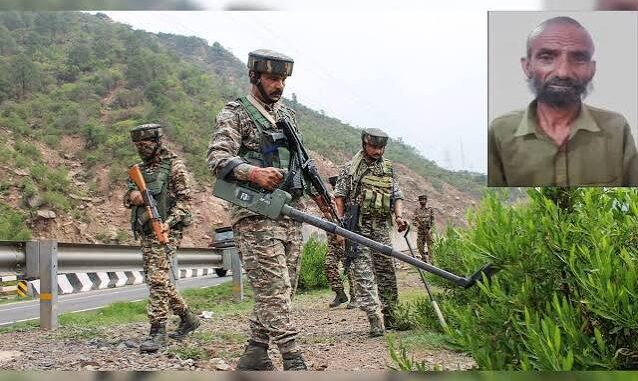
In a significant anti-terror breakthrough, Jammu and Kashmir Police have arrested Haji Latif, an alleged key facilitator of Pakistan-based terrorists. According to the initial investigation, Haji Latif had remained in contact with Pakistan-based terrorists and their handlers for several years. Investigating agencies claim he played a crucial role in facilitating the infiltration of more than 12 Pakistani terrorists into India.
Latif provided logistical support, safe hideouts, and other assistance to infiltrating terrorists. Authorities believe he had been working as a facilitator for cross-border terror networks for a prolonged period. Security agencies are now interrogating Haji Latif to uncover his network, identify Over Ground Workers (OGWs), trace infiltration routes, and gather further intelligence on Pakistan-based terror infrastructure.
Notably, the J&K Police and Indian Armed Forces have strengthened security along the yatra corridor, and even several mock drills have been conducted. The Police in Jammu and Kashmir’s Ganderbal district conducted a mock drill on Sunday to strengthen security for the upcoming Shri Amarnath Ji Yatra (SANJY)-2026.
The drills were conducted at Model Naka Chinner, Kijpora and Margund, focusing on enhancing coordination, preparedness and swift response capabilities among all agencies involved in the smooth conduct of the annual pilgrimage.
The Ganderbal Police, Central Armed Police Forces, State Disaster Response Force, Fire and Emergency Services, Health Department and other concerned stakeholders actively participated in the exercises.
The drills simulated various emergency scenarios to assess the operational readiness, inter-agency coordination, evacuation procedures and response mechanisms.
Amarnath Yatra starts on July 3 and will conclude on August 28, coinciding with Shravan Purnima and Raksha Bandhan festivals. The cave shrine, situated 3,880 feet above sea level, is in the Kashmir Himalayas in the Anantnag district.
Yatris use either the longer traditional Pahalgam base camp route or the shorter Baltal base camp route. Those using the Pahalgam route reach the cave shrine after four days, while those using the Baltal base camp route return to the base camp the same day after having ‘Darshan’ inside the cave shrine.
Bureau Report
Leave a Reply