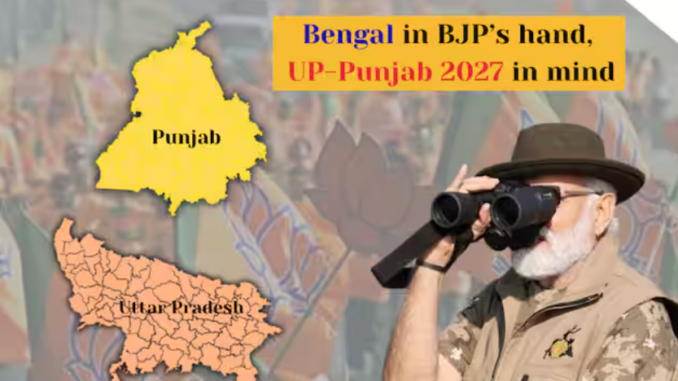
Bengal: Even before the 2nd phase of the voting process was complete in Bengal, the Bhartiya Janata Party was ready with its next campaign. On April 28, four days before polling concluded, Prime Minister Narendra Modi and BJP president Nitin Nabin were in Uttar Pradesh, rallying support and attacking the opposition over the women’s reservation bill. Around the same time, key party functionaries had quietly left Bengal for Delhi to facilitate the defection of seven Aam Aadmi Party MPs, six of them from Punjab, into the BJP. This is how the party operates. Even rivals acknowledge it grudgingly — the BJP rarely takes its eyes off the next prize.
What Bengal Means For Bigger Picture
The West Bengal victory is the most significant state win the BJP has notched since 2014, and the Assam hat-trick adds further momentum. But beyond the celebration, Bengal’s importance lies in what it does to the party’s national arithmetic.
With 42 Lok Sabha seats, Bengal gives the BJP an eastern flank as robust as its traditional strongholds in the north and west. Combined with Bihar and Odisha, where the party’s near-sweep in 2024 pushed its national tally to 240, the eastern corridor now serves as a buffer against any future loss in its established heartlands. The only significant gap that remains is the south, where Karnataka continues to be the party’s lone reliable outpost.
The Bengal win has also reinvigorated the BJP’s ideological footing. The campaign against infiltration, blended with welfare promises and development messaging, proved a potent combination, one that the party’s leadership will not hesitate to deploy elsewhere. Union Minister Dharmendra Pradhan highlighted the victory of Rekha Patra, mother of the RG Kar Medical College rape-murder victim, as evidence that women’s security remains central to the BJP’s political identity.
Uttar Pradesh: The Battle That Cannot Be Lost
UP remains the single most important state on the BJP’s electoral map. With 80 Lok Sabha seats, nearly 15 per cent of the total, it delivered 71 seats in the BJP’s maiden parliamentary majority in 2014. When the SP-led alliance cut that to 33 in 2024, the BJP lost its outright majority and became dependent on allies.
Akhilesh Yadav is expected to press ahead with his PDA coalition, Pichhda, Dalit, Alpsankhyak, after its success in denting the BJP in 2024. The governing party’s response will focus on rebuilding support among non-Yadav OBCs and non-Jatav SCs who drifted away during the Lok Sabha polls. Chief Minister Yogi Adityanath scores well on law and order but has his share of internal detractors, and the party is expected to work towards presenting a united face ahead of next year’s state election.
A senior party functionary was characteristically confident, “The only harm we can suffer in UP is when it is self-inflicted.”
Punjab: The Border State BJP Cannot Ignore
In purely statistical terms, Punjab does not rank among India’s most electorally significant states. But under PM Modi, it has been a persistent priority. The BJP is working to build support among the Sikh majority and the Dalit population, a push that has intensified since its split with the Akali Dal. The defection of AAP’s six Rajya Sabha MPs from the state is part of that effort. They may not be political heavyweights, but their departure weakens Arvind Kejriwal’s organisational base ahead of the 2027 assembly election.
The Broader Cycle
Uttarakhand, where the Congress has shown renewed energy, and Goa are also part of the next electoral cycle. With Nitin Nabin having taken over as BJP president in December last year, an organisational overhaul is expected to bring new faces to the fore, part of a broader effort to balance experience with youth across the party’s rank and file.
The Bengal euphoria will last a few days. The machinery, however, has already moved on.
Leave a Reply