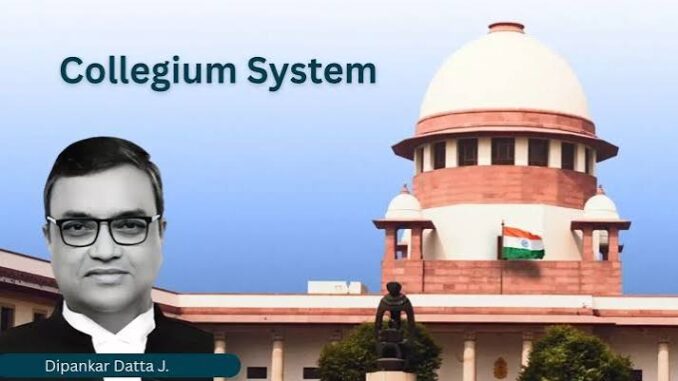
Can an institution remain independent if the process through which its members are appointed is itself seen as lacking sufficient independence? That question lies at the heart of observations made by the Supreme Court Justice Dipankar Datta, one concerning the Collegium system for appointing the judges and the other involving the process for appointing Election Commissioners of the Election Commission of India (ECI).
The Collegium has long faced criticism over the extent of judicial control over judicial appointments, while the ECI appointment process is questioned over the extent of executive participation in selecting the country’s top election officials.
Yet Justice Datta’s observations bring them together around a broader constitutional issue: How should power be divided between the judiciary, the executive and other constitutional actors when appointments are made to institutions expected to function independently?
Judges appoint Judges is a myth: Justice Datta
Justice Datta pushed back against the description of the Collegium as merely a system of “judges appointing judges”.
The remarks came on Wednesday when the Supreme Court questioned the Centre’s selective implementation of Collegium recommendations, with Justice Dipankar Datta observing that the oft-repeated claim that “judges appoint judges” is a “myth”.
Justice Datta said judicial appointments are not made solely by judges but follow a detailed consultative process involving the Executive, intelligence agencies and, ultimately, the President.
His remarks came while rejecting the Centre’s argument that the exclusion of the Chief Justice of India from the selection panel for Election Commissioners could be justified by drawing a parallel with the Collegium system.
Justice Datta said selective approval of Collegium recommendations by the Executive erodes the sanctity of the process. He added that the judiciary has often chosen to proceed with partial clearances to avoid a confrontation that could trigger a constitutional crisis.
He questioned how long such selective implementation could continue, saying the situation had placed the constitutional vision of an independent judiciary under “serious strain”.
“The oft-repeated phrase that ‘judges appoint judges’ is a myth, which people have been fed by vested interests through motivated narratives, often drawing sustenance from certain controversial decisions taken in this century in relation to the appointment of judges,” said Justice Datta.
“A sweeping generalisation that the Collegium acts as a law unto itself overlooks the detailed consultative process envisaged under the Constitution and the intrinsic role of the executive, both at the Centre and in the States, as well as intelligence and other agencies in the appointment process, including vetting of credentials, and the fact that every appointment bears the imprimatur of the President,” he said.
The Appointment of CEC and ECs Act, 2023: What changed?
Justice Datta argued, “For elections to be genuinely free and fair, the Election Commission of India must not only maintain its independence in practice, but must also be widely perceived as independent.”
While noting that the 2023 law excluding the Chief Justice of India from the selection panel might survive a direct constitutional challenge, Justice Datta stressed that it still faces a crucial ‘perception test’, a standard the court has repeatedly deemed essential.
He observed that successive governments over the past seven decades found it convenient to keep constitutionally independent bodies under executive influence, knowing that relinquishing control over the Election Commission under Article 324(2) would create friction for the ruling party.
The argument stems from a change in the mechanism for appointing the Chief Election Commissioner (CEC) and Election Commissioners (EC).
In March 2023, the Supreme Court, in the Anoop Baranwal case, directed that appointment of CEC and ECs be made by a committee comprising the Prime Minister, the Leader of Opposition in the Lok Sabha and the Chief Justice of India until Parliament enacted legislation on the subject.
Parliament subsequently passed the ‘Chief Election Commissioner and Other Election Commissioners Act, 2023’.
However, the new law replaced the Chief Justice of India with a Union Cabinet Minister nominated by the Prime Minister.
The three-member selection committee now comprises the: Prime Minister, Leader of Opposition in the Lok Sabha and a Union Cabinet Minister nominated by the Prime Minister.
The change is central to the current debate because two members of the three-person panel are part of the government, the Prime Minister and the Cabinet Minister nominated by him, while the third is the Leader of Opposition in the Lok Sabha who represents the Opposition.
It can also be argued that executive participation gives an elected government a role in appointments to major constitutional offices. The executive is accountable to Parliament and ultimately to voters, and its participation can therefore be viewed as an element of democratic accountability.
However, the Election Commission requires a particularly strong degree of institutional insulation because it oversees elections in which the incumbent government itself is a participant.
Is executive involvement itself the problem?
This is where the Collegium debate complicates the ECI argument. Every constitutional institution needs checks and balances, if executive involvement in judicial appointments is constitutionally permissible, the argument cannot simply be that the executive should have no role in appointments to independent institutions.
The larger question is, how much influence the executive or any constitutional powers should have, and what safeguards should accompany that influence.
In the Collegium system, the judiciary has a central role in recommending judges, but the executive is part of the subsequent process.
The criticism of the Collegium, on the other hand, is that such a system can place too much appointment power within the judiciary itself, potentially limiting transparency and accountability.
The ECI officials appointment essentially raises the mirror-image concern, the question is whether the executive’s role has become sufficiently prominent that the independence or perceived independence of the institution could be affected.
Justice Datta argued in the same context, he said, “The inclusion of a cabinet minister in the selection committee fails to provide the independent counterweight that a neutral selector could offer.
Instead, the cabinet minister would merely echo the voice of his leader. Consequently, the presence of the Leader of Opposition in the selection committee becomes largely ornamental and fails to serve the purpose for which the position was included.”
Two systems, two competing concerns
In the case of the Collegium, the concern traditionally raised is whether judges have too much control over judicial appointments.
Similarly, in the case of the ECI, the present concern is whether the executive has too much influence over the appointment of election officials.
This is why the composition of an appointment panel matters beyond the individuals who eventually occupy the posts.
Independence and accountability at the centre
Both the arguments ultimately come down to finding a constitutional balance between independence and accountability of an institution.
Judicial independence requires judges to be protected from political pressure, but judicial appointments cannot operate in a complete constitutional vacuum. Similarly, the Election Commission must be free from political influence, while the process of appointing its members must also have a credible basis in democratic governance.
Justice Datta’s observations on the two issues bring them into sharp focus.
The larger issue, therefore, is not simply whether the executive should have a role.
It is where that role should draw the line, what checks should accompany it, and whether the final appointment process can command confidence among institutions and largely the public.
The observations were a part of a split verdict on the Centre’s application seeking reference of challenges to the 2023 act governing the appointment of Election Commissioners to a larger Bench.
While Justice Datta rejected the plea, Justice Satish Chandra Sharma held that the case involved substantial questions of law warranting consideration by a larger Bench.
Bureau Report
Leave a Reply